 DriveQuest

Best Cars for Long Road Trips: Comfort, Mileage & Space
A great road-trip car is about more than simply getting good gas mileage. If you are spending several hours a day behind the wheel, seat comfort, cabin space, cargo room, fuel economy, ride quality, and driving convenience can make a huge difference.
The best cars for long road trips also depend on how you travel. A couple with two small bags has very different needs from a family of six carrying luggage, coolers, and camping gear.
For this guide, I’m focusing on current 2026 models and looking at the things that matter most on long drives: comfort, mileage, passenger space, cargo capacity, practicality, and overall road-trip usefulness. Manufacturer and EPA figures can vary by trim, drivetrain, tires, weather, traffic, and driving habits, so treat them as comparison figures rather than guarantees.
What Makes a Car Good for Long Road Trips?
Before looking at specific vehicles, it helps to understand what you should actually be comparing.
A car can have excellent fuel economy but still be tiring after six hours. Another may have huge cargo space but use substantially more fuel.
For long-distance travel, look at these factors together:
- Comfort: Supportive seats and a relaxed driving position matter on long days.
- Fuel economy: Better MPG can reduce fuel stops and total trip costs.
- Cargo space: Your luggage needs somewhere to go without making the passenger area uncomfortable.
- Rear-seat space: Especially important for families.
- Ride quality: A smooth ride can make rough highways less tiring.
- Driving range: A larger fuel tank combined with good MPG can mean fewer stops.
- Visibility: Good outward visibility makes unfamiliar roads easier to manage.
- Safety and driver assistance: Features such as adaptive cruise control can reduce workload, although they do not replace an attentive driver.
- Maintenance condition: Even an excellent road-trip vehicle is a poor choice if its tires, brakes, battery, or fluids need attention.
Best Cars for Long Road Trips Compared
There isn’t one vehicle that is perfect for every traveler. Here are several types of vehicles worth considering depending on your priorities.
| Vehicle | Best For | Fuel Economy Highlight | Cargo/Space Highlight |
|---|---|---|---|
| Toyota Camry Hybrid | Couples, solo travelers, fuel savings | Up to 51 combined MPG | Sedan trunk; less flexible than SUVs |
| Honda CR-V Hybrid | Couples and small families | 40 city / 34 highway MPG | Up to 76.5 cu. ft. cargo |
| Subaru Outback | Long trips with varied road conditions | Varies by powertrain | Up to 80.5 cu. ft. cargo |
| Hyundai Santa Fe Hybrid | Families needing 3 rows | Up to 36 combined MPG | 40.5 cu. ft. behind second row |
| Toyota Sienna | Larger families | Up to 36 combined MPG | Very large, flexible cabin |
| Ford Explorer | Large families and gear | Up to 29 highway MPG on certain configurations | Up to 85.8 cu. ft. cargo |
These figures are based on manufacturer specifications and can vary by trim and configuration.
Toyota Camry Hybrid: A Fuel-Efficient Choice for Long Highway Drives
Toyota Camry
If your road trips usually involve one or two people and you don’t need SUV-sized cargo space, the 2026 Toyota Camry Hybrid is worth considering.
Toyota’s current Camry lineup uses hybrid powertrains, with some configurations rated as high as 51 combined MPG. Available all-wheel drive adds another option for travelers who regularly encounter slippery conditions.
The big advantage is simple: you can cover a lot of highway miles without using as much fuel as many larger vehicles.
Why it works for road trips
- Excellent fuel economy on qualifying configurations
- Comfortable sedan layout
- Available AWD
- Good choice for couples or solo travelers
- Potentially lower fuel spending over high annual mileage
Where it may not work
The Camry is not the obvious choice if you’re carrying luggage for five people, camping equipment, or bulky family gear.
If you regularly fill the trunk, a crossover, SUV, or minivan may be more practical.
Honda CR-V Hybrid: A Practical Balance of Mileage and Space
Honda CR-V
The 2026 Honda CR-V Hybrid is a strong example of why crossovers are popular for road trips.
Honda lists the hybrid at 40 city/34 highway MPG for the applicable configuration, while the CR-V offers up to 76.5 cubic feet of cargo space with the rear seats folded.
That combination is useful when you want better fuel economy without moving into a much larger SUV.
Why road trippers may like it
- Good balance of efficiency and cargo space
- Higher seating position than a sedan
- Foldable rear seats
- Available AWD
- Useful for couples, small families, and active travelers
- Easier to load bulky luggage than a traditional sedan
The CR-V is especially practical if your trip involves both passengers and equipment. You can keep the rear seats available for passengers and still use the cargo area for bags, coolers, backpacks, and other essentials.
Subaru Outback: Useful for Long Trips With More Varied Roads
Subaru Outback
The 2026 Subaru Outback takes a slightly different approach. It provides the practicality of a crossover while retaining a wagon-like profile.
Subaru lists 80.5 cubic feet of maximum cargo capacity with the rear seatbacks lowered. The 2026 model also has 43 inches of front legroom and 39.5 inches of rear legroom.
That makes it particularly useful when your road trip involves luggage, outdoor equipment, or roads where extra capability is useful.
Why consider the Outback?
- Large cargo area
- Good passenger space
- Standard ground clearance of 8.7 inches on many configurations
- Available higher-capability versions
- Useful roof-rail setup for additional equipment
The important point is not to choose a vehicle based solely on the word “adventure.” Think about the roads you will actually drive.
If your trip is 95% interstate highway, you may not need an off-road-oriented configuration that trades some efficiency for capability.
Hyundai Santa Fe Hybrid: A Family-Friendly Road Trip SUV
Hyundai Santa Fe
For families who want three rows without immediately jumping to a large full-size SUV, the 2026 Hyundai Santa Fe Hybrid is an interesting option.
Hyundai lists up to 36 combined MPG for the front-wheel-drive hybrid and 34 combined MPG for AWD versions. It has three rows and provides 40.5 cubic feet of cargo space behind the second row and 79.6 cubic feet behind the first row.
That gives you more flexibility when passengers and luggage are competing for space.
The important catch
Three rows don’t automatically mean three rows of luggage space.
When all three rows are occupied, the Santa Fe has only 14.6 cubic feet behind the third row according to Hyundai’s specifications.
So if seven people are traveling with large suitcases, you’ll need to plan carefully.
Toyota Sienna: One of the Most Practical Choices for Families
Toyota Sienna
If your priority is carrying people and luggage comfortably, don’t overlook the minivan.
The 2026 Toyota Sienna is a hybrid-only model, with Toyota listing up to 36 MPG city and 36 MPG highway for applicable configurations. AWD is also available.
The Sienna’s biggest advantage isn’t just fuel economy. It’s the combination of passenger space, flexible seating, sliding doors, and cargo capacity.
Toyota’s comparison information lists up to 101 cubic feet of cargo capacity behind the rear seats folded, depending on the comparison configuration.
Why a minivan can make sense for road trips
- Excellent family-oriented interior flexibility
- Easy loading and unloading
- Lots of room for passengers
- Large cargo capacity
- Hybrid powertrain
- Available AWD
- Useful for long family vacations
If you regularly travel with children, grandparents, luggage, snacks, coolers, and travel equipment, a minivan can make more sense than choosing an SUV simply because SUVs are popular.
Ford Explorer: More Space for Larger Families and Gear
Ford Explorer
The 2026 Ford Explorer is another option for travelers who need three rows.
Ford lists seating for up to seven, with 46 cubic feet behind the second row and up to 85.8 cubic feet behind the first row on applicable configurations.
Fuel economy depends heavily on the engine and drivetrain. For example, Ford lists up to 20 city/29 highway MPG for the 2.3-liter rear-wheel-drive configuration on certain trims.
When the Explorer makes sense
It can be worth considering if you need:
- Three-row seating
- Significant cargo capacity
- Available four-wheel drive
- More towing capability
- Space for a larger family
But don’t choose a large SUV solely for its size. If you normally travel with two people, a smaller and more efficient vehicle may be easier to live with and less expensive to fuel.
How Much Does Fuel Economy Matter on a Long Road Trip?
This is where a small MPG difference can become meaningful.
Suppose you’re driving 1,500 miles.
Imagine one vehicle gets 25 MPG and another gets 35 MPG.
Vehicle A: 25 MPG
Fuel needed:
1,500 ÷ 25 = 60 gallons
Vehicle B: 35 MPG
Fuel needed:
1,500 ÷ 35 = 42.9 gallons
That’s a difference of about 17.1 gallons over the trip.
If fuel happens to cost $3.50 per gallon:
- 25 MPG vehicle: 60 × $3.50 = $210
- 35 MPG vehicle: 42.9 × $3.50 ≈ $150
- Difference: approximately $60
This is an example, not a current universal fuel price. Actual fuel prices vary considerably by location and date.
The simple road-trip fuel formula
You can reuse this formula for almost any vehicle:
Fuel needed = Total miles ÷ Actual MPG
Then:
Fuel cost = Fuel needed × Price per gallon
For example:
| Item | Example |
|---|---|
| Trip distance | 1,500 miles |
| Vehicle economy | 35 MPG |
| Fuel needed | 42.9 gallons |
| Example fuel price | $3.50/gal |
| Estimated fuel cost | ~$150 |
Remember to calculate the full trip distance, not just the distance from home to your destination.
Don’t Choose a Road Trip Car Based on MPG Alone
A vehicle’s advertised MPG is useful for comparisons, but it doesn’t tell you exactly what you’ll get.
Your real-world fuel economy can change because of:
- Highway speed
- Heavy traffic
- Hills and mountains
- Strong wind
- Cold weather
- Air conditioning
- Tire pressure
- Vehicle load
- Roof boxes or racks
- Aggressive acceleration
- Stop-and-go driving
That’s why I prefer treating official MPG numbers as a planning baseline rather than a promise.
If you’re budgeting tightly, leave some room between your calculated fuel cost and your actual spending.
How Much Space Do You Really Need?
More cargo space sounds better until you realize that you’re paying for and driving a larger vehicle every day.
Before choosing a vehicle, make a rough packing list.
For a couple, you might need:
- 2 medium suitcases
- 2 backpacks
- Cooler
- Camera or electronics
- Road-trip snacks
- Emergency kit
A family might need:
- 4–6 suitcases
- Stroller
- Children’s bags
- Cooler
- Sports or outdoor equipment
- Extra food and drinks
Then ask an important question:
Can everything fit without blocking the driver’s view or making passengers uncomfortable?
Don’t simply look at the maximum cargo number. Think about how the space is shaped and how easily you can access it.
Comfort Features That Matter on Long Drives
You don’t necessarily need a luxury car for a comfortable road trip.
Some relatively ordinary features can make a noticeable difference:
Supportive front seats
A seat that feels comfortable for 20 minutes isn’t necessarily comfortable after five hours.
If possible, sit in the driver’s seat for at least 15–20 minutes before buying.
Adjustable driving position
Look for enough steering-wheel and seat adjustment to let you maintain a relaxed posture.
Good climate control
Long trips can become miserable when one passenger is hot while another is cold.
Dual-zone climate control can be particularly useful for couples and families.
Adaptive cruise control
This can reduce the workload during steady highway driving, but you still need to remain attentive and ready to control the vehicle.
Good storage
Cupholders and small storage areas sound trivial until everyone has a phone, water bottle, sunglasses, charging cable, snacks, and other small items.
What Type of Car Is Best for Your Road Trip?
Instead of asking “What is the best road-trip car?” ask “What is the best road-trip car for my trip?”
For solo travelers
A fuel-efficient sedan or compact crossover can be enough.
You probably don’t need three rows and enormous cargo capacity unless you carry specialized equipment.
For couples
A sedan such as the Camry Hybrid can work very well if luggage requirements are modest.
A compact SUV such as the CR-V gives you more flexible cargo space.
For a small family
A compact or midsize SUV can provide a useful balance of passenger room, cargo capacity, and fuel economy.
For large families
Three-row SUVs and minivans become much more practical.
If everyone is carrying luggage, don’t forget to test the cargo area with all seats occupied.
For outdoor-focused trips
A vehicle such as the Outback may make more sense when ground clearance, cargo flexibility, and rougher roads are important.
How to Prepare Your Car Before a Long Road Trip
Even the right vehicle needs preparation.
A week or two before departure, check:
- Tire pressure
- Tire condition and tread
- Engine oil
- Coolant
- Brake condition
- Battery
- Windshield washer fluid
- Lights
- Spare tire or tire-repair equipment
- Wipers
If your vehicle is due for scheduled maintenance, don’t wait until you’re hundreds of miles from home.
Also make sure you know where the owner’s manual is and understand the basic warning lights on your dashboard.
Common Mistakes When Choosing a Road Trip Car
Choosing based only on fuel economy
A 40-MPG vehicle isn’t necessarily the right choice if it can’t comfortably carry your passengers and luggage.
Buying more car than you need
A huge SUV may sound ideal, but if two people are traveling with two bags, its additional size may provide little practical benefit.
Ignoring rear-seat comfort
If children or adults will spend hours in the back, have them sit there before you buy.
Forgetting luggage space
Always test your actual luggage if possible.
Assuming highway MPG is what you’ll always get
Official ratings are useful comparison figures, not guarantees.
Ignoring tire and maintenance costs
Fuel is only one part of the cost of owning and operating a road-trip vehicle.
Overlooking driving range
Two cars can have similar MPG but different fuel-tank sizes. That can affect how often you need to stop for fuel.
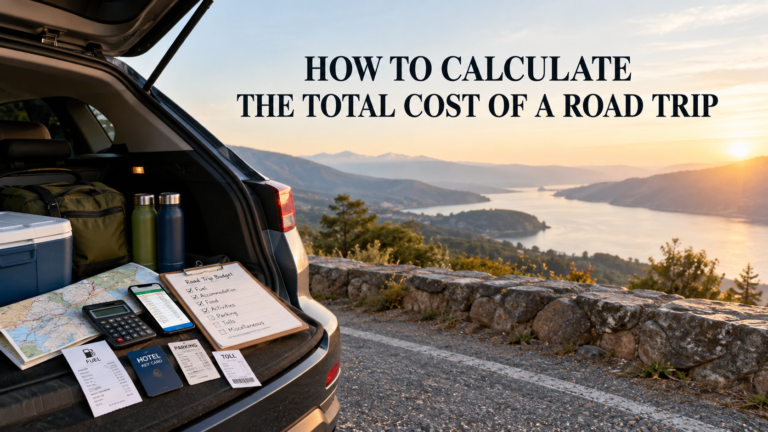
How to Estimate Your Total Road Trip Fuel Cost
Here’s a simple example you can adapt.
Imagine:
- Total distance: 2,000 miles
- Vehicle: 30 MPG
- Example fuel price: $3.50 per gallon
First calculate fuel:
2,000 ÷ 30 = 66.7 gallons
Then calculate the cost:
66.7 × $3.50 ≈ $233
So your estimated fuel cost would be about $233.
But don’t stop there.
Your actual road-trip budget could also include:
| Expense | Example Budget |
|---|---|
| Fuel | $233 |
| Hotels | $400 |
| Food | $250 |
| Tolls | $75 |
| Parking | $50 |
| Activities | $150 |
| Emergency buffer | $150 |
| Estimated Total | $1,308 |
These are illustrative numbers, not typical or guaranteed prices. Hotel rates, fuel prices, tolls, food costs, and activities can vary substantially by destination and travel dates.
How to Save Money Without Making the Trip Miserable
You don’t have to turn your vacation into a financial endurance test.
Try these practical approaches:
- Keep tires properly inflated according to the vehicle manufacturer’s recommendations.
- Avoid carrying unnecessary heavy items.
- Combine errands and stops when practical.
- Compare fuel prices along your route.
- Pack drinks and some snacks.
- Book hotels strategically around your driving route.
- Avoid expensive parking when practical.
- Don’t choose a longer route just because it has cheaper fuel.
- Build an emergency buffer into your budget.
- Use the vehicle’s actual MPG from previous trips when available instead of relying only on its advertised rating.
One of the easiest ways to save is often simply planning the route properly.
A 30-mile detour to save a few cents per gallon may cost more in fuel than it saves.
How to Choose the Right Car for Your Next Road Trip
Before choosing a vehicle, answer these questions:
- How many people are traveling?
- How much luggage will you carry?
- How many miles will you drive?
- Will most driving be highway or city?
- Will you encounter snow, mountains, dirt roads, or poor road conditions?
- How important is fuel economy?
- Do you need three rows?
- Do you need AWD or additional ground clearance?
- Will you tow anything?
- What is your total vehicle and travel budget?
Once you answer those questions, the shortlist usually becomes much smaller.
For example, a couple driving 2,000 highway miles with limited luggage may prioritize fuel economy and front-seat comfort. A family of six driving across several states may care much more about third-row comfort and usable cargo space.
Frequently Asked Questions
Final Takeaway
The best cars for long road trips aren’t necessarily the biggest, cheapest, or most fuel-efficient vehicles.
The right choice is the vehicle that matches your passengers, luggage, driving conditions, fuel budget, and comfort needs.
For two people focused on fuel economy, a hybrid sedan such as the Camry can make sense. For travelers who want a balance of cargo space and efficiency, a CR-V Hybrid is worth considering. Families may benefit from the additional flexibility of the Santa Fe Hybrid or Sienna, while the Outback and Explorer offer different combinations of cargo space and capability.
Before you leave, calculate your total mileage, expected fuel cost, and complete trip budget. Then check the tires, fluids, brakes, battery, and luggage space.
That small amount of preparation can make a long drive much more comfortable—and help keep your road-trip budget under control.