 DriveQuest
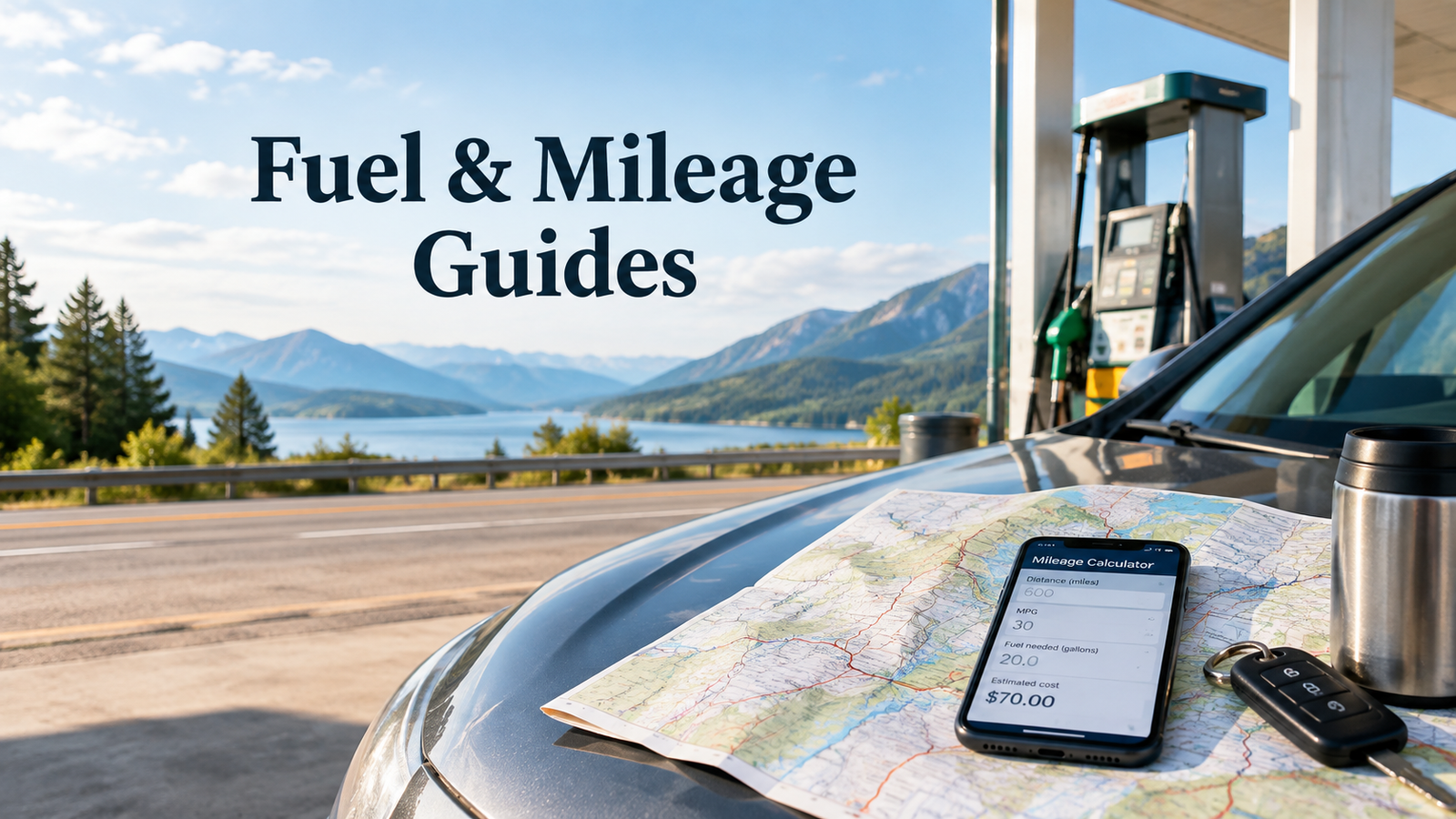
Fuel & Mileage Guides: How to Calculate Road Trip Fuel Costs & Mileage
Planning a road trip is exciting until you start wondering, “How much am I actually going to spend on fuel?”
The good news is that you don’t need complicated math to get a useful estimate. With your trip distance, vehicle mileage, and local fuel price, you can calculate how much fuel you’ll need and create a much more realistic road trip budget.
This guide explains how fuel mileage works, how to calculate road trip fuel costs, and which real-world factors can make your actual fuel use different from the estimate.
What Are Fuel & Mileage Guides?
Fuel & Mileage Guides help travelers understand how far their vehicle can travel, how much fuel a trip may require, and how much that fuel could cost.
The basic information you need is:
- Total trip distance
- Vehicle fuel economy
- Fuel price
- One-way or round-trip distance
- Expected driving conditions
- Number of stops and detours
Once you have these numbers, the calculation is fairly simple.
How to Calculate Fuel Costs for a Road Trip
If your vehicle uses miles per gallon (MPG), use this formula:
Fuel Required = Total Distance ÷ MPG
Then:
Fuel Cost = Fuel Required × Price Per Gallon
Simple Example
Suppose your road trip is 900 miles and your vehicle gets 30 MPG.
900 ÷ 30 = 30 gallons
If fuel costs $3.50 per gallon:
30 × $3.50 = $105
So your estimated fuel cost would be $105.
This is an example rather than a guaranteed real-world cost. Fuel prices vary by location and date, and your vehicle may achieve different mileage depending on how and where you drive.
How to Calculate Road Trip Fuel Costs in 4 Steps
You can calculate your estimated fuel cost before leaving home with these four steps.
1. Find Your Total Distance
Start with the distance you expect to drive.
Don’t automatically use only the distance between your starting point and destination. A road trip usually includes:
- Detours
- Restaurant stops
- Sightseeing
- Hotel travel
- Local driving
- Getting around your destination
If your planned route is 450 miles each way, your basic round-trip distance is:
450 × 2 = 900 miles
You can then add some additional mileage if you expect to drive around during the trip.
2. Check Your Vehicle’s MPG
Your vehicle’s fuel economy tells you approximately how many miles it can travel using one gallon of fuel.
For example:
| Vehicle Mileage | Approximate Meaning |
|---|---|
| 20 MPG | Uses more fuel per mile |
| 25 MPG | Moderate fuel economy |
| 30 MPG | Relatively efficient |
| 35 MPG | Higher fuel economy |
| 40 MPG | Very fuel-efficient |
Your actual mileage may differ from the advertised figure.
Highway driving can produce different results from city driving, while heavy traffic, hills, weather, passengers, and cargo can also affect fuel consumption.
3. Calculate Fuel Required
Use:
Total Distance ÷ MPG = Gallons Needed
For example:
1,200 miles ÷ 25 MPG = 48 gallons
Your estimated fuel requirement is therefore 48 gallons.
4. Multiply by the Fuel Price
If fuel costs $3.40 per gallon:
48 × $3.40 = $163.20
Your estimated fuel expense would be $163.20.
Again, this is only an estimate. Checking current fuel prices along your actual route will give you a more useful budget.
MPG vs. KM/L: What’s the Difference?
Drivers in different countries may see fuel economy expressed in different ways.
In the United States, MPG (miles per gallon) is commonly used.
In many other countries, fuel economy may be expressed as KM/L (kilometers per liter).
The basic idea is the same: both measurements tell you how far a vehicle can travel using a specific amount of fuel.
For example, if a vehicle gets 15 KM/L, it can theoretically travel about 15 kilometers using one liter of fuel under the conditions represented by that figure.
When planning an international road trip, make sure you’re using the correct units before doing your calculations.
Don’t Forget the Return Trip
One of the easiest road trip budgeting mistakes is calculating fuel for the journey to your destination but forgetting the drive home.
If your destination is 600 miles away:
One-way distance = 600 miles
Round-trip distance = 1,200 miles
At 30 MPG:
1,200 ÷ 30 = 40 gallons
If you only calculated 600 miles, you’d estimate 20 gallons and potentially budget for only half of your actual driving distance.
City Mileage vs. Highway Mileage
Your vehicle may not use the same amount of fuel everywhere.
Stop-and-go city driving can produce different fuel consumption from steady highway driving.
Your mileage can also change because of:
- Traffic congestion
- Frequent acceleration
- Long periods of idling
- Steep hills
- High speeds
- Weather conditions
- Heavy cargo
- Tire pressure
- Air conditioning use
- Driving style
This is why using your vehicle’s advertised MPG as an exact guarantee can produce an unrealistic budget.
A Better Approach
If you know your vehicle’s real-world average mileage, use that number instead.
For example, if your vehicle is advertised at 30 MPG but you normally get around 27 MPG on longer trips, using 27 MPG can give you a more conservative estimate.
How Much Fuel Do You Need for a 1,000-Mile Road Trip?
It depends on your vehicle’s fuel economy.
Here’s a simple comparison:
| Vehicle Mileage | Fuel for 1,000 Miles |
|---|---|
| 20 MPG | 50 gallons |
| 25 MPG | 40 gallons |
| 30 MPG | 33.3 gallons |
| 35 MPG | 28.6 gallons |
| 40 MPG | 25 gallons |
The calculation is always:
1,000 ÷ MPG = Estimated Gallons
This table doesn’t include the fuel price because that changes depending on where and when you travel.
How to Estimate Fuel Cost for Different Road Trips
Here’s an example using a hypothetical fuel price of $3.50 per gallon.
| Trip Distance | Vehicle Mileage | Estimated Fuel | Example Fuel Cost |
|---|---|---|---|
| 500 miles | 25 MPG | 20 gal | $70 |
| 750 miles | 25 MPG | 30 gal | $105 |
| 1,000 miles | 25 MPG | 40 gal | $140 |
| 1,500 miles | 25 MPG | 60 gal | $210 |
| 2,000 miles | 25 MPG | 80 gal | $280 |
These figures are examples for calculation purposes, not current universal fuel prices.
Your actual cost depends on the price you pay at the stations along your route.
What Can Increase Your Road Trip Fuel Costs?
The basic calculation assumes relatively consistent conditions. Real road trips aren’t always that simple.
Heavy Vehicle Loads
A packed vehicle carrying several passengers, luggage, camping equipment, or other gear may use more fuel than an unloaded vehicle.
You don’t need to remove everything from your car, but avoiding unnecessary weight can help keep fuel use reasonable.
Aggressive Acceleration
Frequent hard acceleration and sudden changes in speed can increase fuel consumption.
Smooth, predictable driving is generally a more sensible approach for both fuel planning and comfortable long-distance travel.
High Speeds
Driving at higher speeds can change fuel consumption compared with moderate highway driving.
If you’re calculating a trip budget, don’t assume your vehicle will always achieve its best advertised mileage.
Mountain Roads
Hilly and mountainous routes can require more energy than flat roads.
A route that looks similar in distance may therefore produce different fuel consumption depending on terrain and driving conditions.
Traffic and Idling
A 300-mile journey isn’t necessarily the same from a fuel perspective if one trip has smooth highway traffic and another involves hours of congestion.
Long delays, frequent stops, and unnecessary idling can all affect your actual fuel use.
How to Make Your Fuel Estimate More Realistic
Instead of treating your calculation as an exact number, think of it as a starting estimate.
A practical process is:
- Calculate your total planned mileage.
- Use your vehicle’s realistic MPG.
- Calculate estimated fuel required.
- Check fuel prices along your route.
- Add expected local driving.
- Leave some room for unexpected detours.
- Include fuel as part of your complete road trip budget.
This approach gives you a more useful number than simply entering the destination into a calculator and assuming the result will match your final spending.
Simple Road Trip Fuel Calculator Formula
You can save these formulas for future trips.
If You Use MPG
Fuel Needed = Distance ÷ MPG
Fuel Cost = Fuel Needed × Fuel Price
Example
Distance: 1,500 miles
Mileage: 30 MPG
Fuel price: $3.50/gallon
1,500 ÷ 30 = 50 gallons
50 × $3.50 = $175
Estimated fuel cost: $175
If You Use KM/L
The same basic concept applies:
Fuel Needed = Distance in KM ÷ KM/L
Then multiply the fuel amount by the price per liter.
Always make sure the distance, fuel economy, and fuel price use compatible units.
How to Save Money on Road Trip Fuel
You don’t need extreme “fuel hacks” to reduce unnecessary spending.
A few practical habits can help.
Compare Fuel Prices
Fuel prices can vary between locations, so checking prices along your route can help you avoid unnecessarily expensive stops.
Don’t drive a long distance just to save a tiny amount, though. The extra mileage can cancel out the savings.
Keep Your Tires Properly Inflated
Check your vehicle’s recommended tire pressure before a long trip.
Properly maintained tires can help your vehicle operate as intended.
Avoid Unnecessary Detours
Extra miles mean extra fuel.
If you’re already planning several stops, grouping nearby attractions together can reduce unnecessary backtracking.
Pack Snacks and Drinks
If you’re trying to control the overall road trip budget, bringing some food and drinks can reduce the number of convenience-store stops.
It won’t change your MPG, but it can reduce total travel spending.
Combine Stops
Instead of making separate trips for fuel, groceries, food, and other necessities, combine stops when practical.
This can make the trip more efficient and reduce unnecessary local driving.
Fuel Costs Are Only One Part of a Road Trip Budget
Fuel is important, but it isn’t the entire cost of a road trip.
Depending on your trip, you may also need to budget for:
| Expense | What to Consider |
|---|---|
| Fuel | Distance, MPG, fuel prices |
| Accommodation | Hotels, motels, campsites |
| Food | Restaurants, groceries, snacks |
| Tolls | Route and toll roads |
| Parking | Cities, attractions, hotels |
| Maintenance | Oil, tires, servicing |
| Attractions | Tickets and activities |
| Emergency Buffer | Unexpected expenses |
A trip that looks inexpensive based on fuel alone can become much more expensive once these costs are included.
Common Fuel and Mileage Mistakes
Using One-Way Distance
Always check whether your distance represents the complete trip or only the journey to your destination.
Using the Highest Advertised MPG
Your vehicle may not achieve its maximum advertised mileage in every situation.
Forgetting Local Driving
Sightseeing and errands can add significant mileage to a longer trip.
Ignoring Fuel Price Differences
The price you pay at home may not be the same as the price along your route.
Treating the Estimate as Exact
Fuel calculations are planning tools, not guarantees.
Weather, traffic, driving style, road conditions, vehicle load, and other factors can change the final number.
Frequently Asked Questions
Final Takeaway
Good Fuel & Mileage Guides aren’t about predicting your fuel bill down to the last dollar. They’re about giving you a realistic starting point before you leave home.
First, calculate your total mileage. Then use your vehicle’s realistic fuel economy, estimate the fuel required, check current prices along your route, and leave room for local driving and unexpected changes.
Before departure, it’s also worth checking your tires, vehicle condition, route, and planned fuel stops. A few minutes of preparation can make your road trip budget much easier to manage.