 DriveQuest
Long-Distance Road Trip Planning: A Practical Guide for a Stress-Free Journey
Planning a long-distance road trip sounds exciting until you start thinking about fuel, driving hours, overnight stops, food, weather, vehicle preparation, and unexpected expenses. A little planning before departure can make the difference between a relaxed trip and one where you’re constantly checking the clock and worrying about money.
This long-distance road trip planning guide walks you through the process step by step, from calculating your driving distance and fuel costs to choosing overnight stops, preparing your car, building a realistic budget, and leaving room for the unexpected.
What Is Long-Distance Road Trip Planning?
Long-distance road trip planning means preparing for the practical details of a trip that covers a significant distance, often across multiple cities, regions, or states.
It involves more than simply entering a destination into a navigation app. You need to think about:
- Total mileage
- Driving time
- Fuel stops
- Overnight accommodation
- Meals and snacks
- Tolls and parking
- Vehicle condition
- Weather and road conditions
- Rest breaks
- Emergency expenses
- Activities and detours
The goal isn’t to create a schedule where every minute is planned. It’s to know the important details before you leave so you can make better decisions along the way.
Start With Your Total Distance
Your first step should be figuring out how many miles or kilometers you’ll actually drive.
Don’t calculate only the distance from your home to your destination. A realistic road trip distance can include:
- The outbound journey
- Local driving at your destination
- Sightseeing detours
- Driving to restaurants and attractions
- The return journey
For example, imagine your main route is 900 miles each way.
Your basic round-trip distance is:
900 × 2 = 1,800 miles
If you expect another 150 miles of local driving and sightseeing:
1,800 + 150 = 1,950 miles
That 1,950-mile figure is much more useful for your fuel and budget calculations.
Add a Small Distance Buffer
Your planned route isn’t always the route you’ll actually drive.
Road closures, missed turns, detours, alternate routes, and spontaneous stops can add mileage. Rather than assuming your navigation app’s exact number will be your final mileage, build a reasonable buffer into your estimate.
The appropriate amount depends on your trip. A route with several cities and attractions may require a larger buffer than a simple point-to-point drive.
Estimate Your Total Driving Time
Distance alone doesn’t tell you how demanding a road trip will be.
A 500-mile day can feel very different depending on traffic, terrain, weather, road quality, construction, and how often you stop.
Start with:
Estimated driving time = Distance ÷ Average driving speed
But don’t assume you’ll maintain your highway speed for the entire journey.
Fuel stops, meals, bathroom breaks, traffic, construction, and rest stops all add time.
Don’t Plan Every Day Around Maximum Driving
One common mistake in long-distance road trip planning is trying to cover too much ground every day.
A schedule might look efficient on paper:
Drive 10–12 hours → check in → sleep → repeat
But this can leave you exhausted and make the trip feel like transportation rather than travel.
Instead, consider:
- How many hours you’re genuinely comfortable driving
- How frequently you need breaks
- Whether another person can share driving
- Whether you’re traveling with children
- Whether you’ll encounter mountain roads or heavy traffic
- Whether you’ll arrive at your hotel before dark
A slightly slower itinerary can often make the overall experience much more manageable.
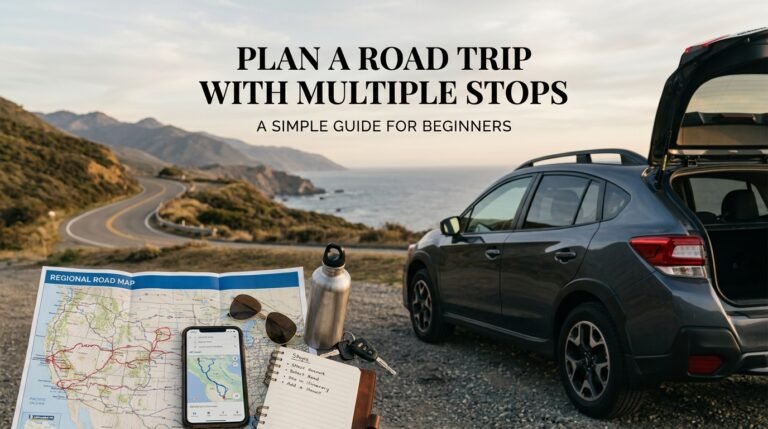
Build Your Route Around Realistic Stops
Once you know your approximate distance and driving time, divide the trip into manageable sections.
For a multi-day trip, identify:
- Starting point
- Major stops along the route
- Fuel areas
- Meal stops
- Overnight locations
- Attractions or detours
- Final destination
You don’t necessarily need to book every stop in advance. But knowing where you expect to stop gives you a backup plan when you’re tired or running behind schedule.
Choose Overnight Stops Strategically
Your overnight location doesn’t always need to be the halfway point.
Look at:
- Hotel availability
- Parking
- Distance from the highway
- Nearby restaurants
- Safety and convenience
- Expected arrival time
- The following day’s driving distance
For example, stopping 50 miles earlier may make sense if it gives you a more convenient hotel and leaves you with a manageable drive the next morning.
Calculate Fuel Costs Before You Leave
Fuel is one of the easiest road trip expenses to estimate if you know your vehicle’s fuel economy.
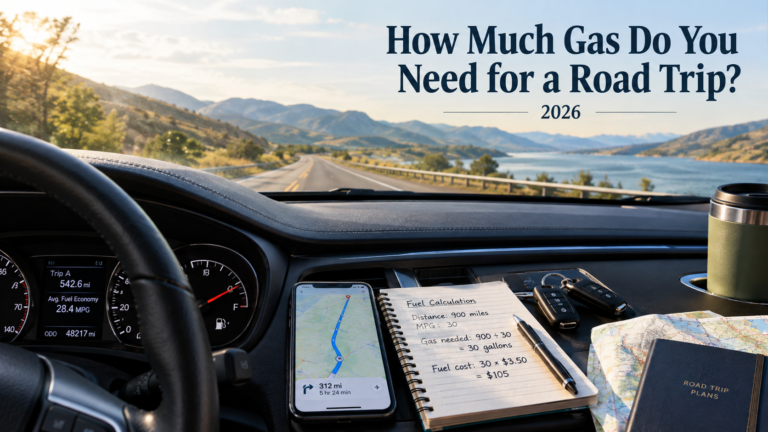
The basic formula is:
Fuel needed = Total distance ÷ Vehicle MPG
Then:
Fuel cost = Fuel needed × Price per gallon
Example: 1,950-Mile Road Trip
Suppose:
- Total distance = 1,950 miles
- Vehicle fuel economy = 30 MPG
- Example fuel price = $3.50 per gallon
Fuel required:
1,950 ÷ 30 = 65 gallons
Estimated fuel cost:
65 × $3.50 = $227.50
So your estimated fuel cost would be about $228 under these assumptions.
Actual spending can differ because fuel prices vary by location and date, and your real-world MPG may be different from the vehicle’s advertised figure.
If You Use KM/L
For vehicles measured in kilometers per liter:
Fuel needed = Total distance in kilometers ÷ KM/L
Then:
Fuel cost = Liters required × Price per liter
The same basic principle applies: determine how much fuel your vehicle needs, then multiply that amount by the fuel price.
Don’t Rely Entirely on the Vehicle’s Advertised MPG
Your actual fuel economy can change based on:
- Highway versus city driving
- Speed
- Traffic
- Weather
- Tire pressure
- Vehicle load
- Roof racks or cargo carriers
- Air conditioning use
- Driving habits
- Road elevation
If your car is rated at 30 MPG, using exactly 30 MPG for your budget may be reasonable for a rough estimate, but using your own historical fuel economy can give you a more useful number.
Plan Your Fuel Stops
Don’t wait until the fuel gauge is nearly empty before looking for a gas station.
Before long stretches of highway, especially rural roads, check where your likely fuel stops will be.
A simple approach is to refuel when you have enough fuel remaining to comfortably reach the next reliable station.
This is especially important if:
- You’re traveling through remote areas
- Weather is poor
- You’re driving at night
- Your vehicle has a small fuel tank
- You don’t know the route well
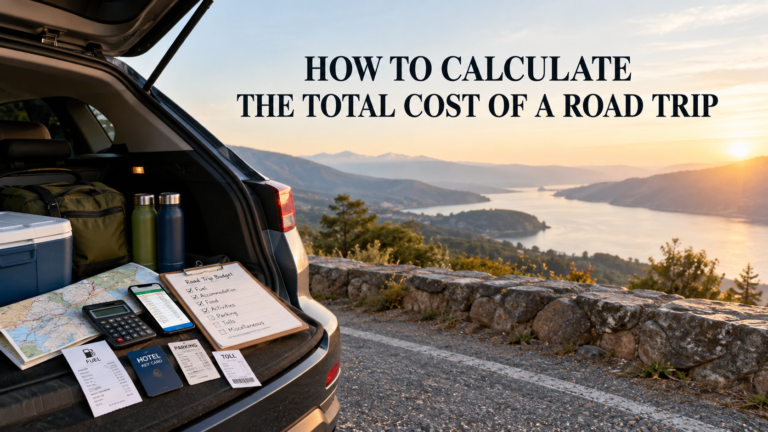
Create a Complete Road Trip Budget
Fuel is only one part of the cost.
A more realistic budget should include the following:
| Expense | Example Budget |
|---|---|
| Fuel | $228 |
| Accommodation | $450 |
| Food | $300 |
| Tolls | $80 |
| Parking | $50 |
| Activities | $150 |
| Miscellaneous | $75 |
| Emergency buffer | $200 |
| Estimated Total | $1,533 |
These are illustrative numbers, not universal prices. Actual costs depend heavily on destination, travel dates, vehicle, accommodation, number of travelers, and personal spending habits.
Think About Costs Per Person
If four people share the example $1,533 trip:
$1,533 ÷ 4 = $383.25 per person
But don’t automatically divide every expense equally.
For example, one person may pay for parking while another pays for meals. Families may also have different spending patterns than groups of adults.
For planning purposes, though, a per-person estimate can help you understand whether the overall trip fits your budget.
Separate Fixed and Variable Costs
This makes your budget easier to adjust.
Fixed or Mostly Fixed Costs
These may include:
- Hotel reservations
- Rental car charges
- Attraction tickets
- Travel insurance
- Pre-booked activities
Variable Costs
These can change during the trip:
- Fuel
- Food
- Parking
- Tolls
- Snacks
- Shopping
- Extra activities
Knowing the difference helps you see where you have flexibility if the trip starts costing more than expected.
Don’t Forget Accommodation Costs
Hotels can become one of the largest expenses on a long road trip.
Before booking, check the actual price rather than relying only on the advertised nightly rate.
Look for potential additional charges such as:
- Taxes
- Parking fees
- Resort or destination fees where applicable
- Pet fees
- Extra-person charges
- Cancellation restrictions
The final amount depends on the property and destination, so review the booking details before confirming.
Consider Location, Not Just Price
A cheaper hotel far outside your route isn’t necessarily cheaper if it adds significant driving.
Compare the total convenience and cost, including:
- Extra fuel
- Additional driving time
- Parking
- Meals
- Traffic
Sometimes paying slightly more for a convenient location can reduce other costs and make the trip easier.
Plan Food Without Overcomplicating It
Food spending can quietly push a road trip budget higher.
A simple strategy is to combine purchased meals with food you carry yourself.
Pack practical items such as:
- Water
- Fruit
- Nuts
- Sandwiches
- Granola bars
- Crackers
- Other shelf-stable snacks
You don’t need to pack every meal. Even replacing a few expensive roadside purchases can make a noticeable difference.
Also remember that travelers often spend more on food when they’re tired and haven’t planned their next meal.
Prepare Your Vehicle Before a Long Trip
A long-distance trip puts more miles on your vehicle in a short period, so basic preparation matters.
Before departure, check:
- Tire pressure
- Tire condition
- Engine oil
- Coolant
- Brake condition
- Lights
- Windshield wipers
- Battery condition
- Spare tire or tire repair equipment
- Jack and basic tools
If your vehicle is due for scheduled maintenance, dealing with it before the trip is generally easier than discovering a problem hundreds of miles from home.
Don’t Ignore Warning Signs
If your vehicle has unusual noises, warning lights, steering problems, overheating, braking issues, or other significant problems, don’t treat the road trip as a test drive.
Get the issue assessed before setting out.
Check Weather and Road Conditions
Weather can change both your route and your schedule.
Before each major driving day, check conditions along the route rather than only checking the forecast for your destination.
Pay attention to:
- Heavy rain
- Snow and ice
- Strong winds
- Flooding
- Extreme temperatures
- Mountain conditions
- Road closures
- Construction
If conditions become unsafe, changing your schedule is more important than sticking to an arbitrary arrival time.
Keep Important Documents Accessible
Depending on where you’re traveling, keep necessary documents easy to reach.
These may include:
- Driver’s license
- Vehicle registration
- Insurance information
- Hotel reservations
- Rental car documents
- Emergency contact information
- Travel documents required for your route
It’s also useful to keep digital copies where appropriate, while retaining access to originals when required.
Build an Emergency Buffer Into Your Budget
A road trip without an emergency fund can become stressful very quickly.
Unexpected expenses might include:
- Tire repairs
- Towing
- Emergency accommodation
- Medical expenses
- Extra fuel
- Unexpected route changes
- Replacement travel equipment
You don’t need to predict exactly what will go wrong.
Instead, set aside money specifically for things you didn’t plan for.
A useful rule is to treat your emergency buffer as money you hope not to spend, rather than money available for souvenirs or extra activities.
Long-Distance Road Trip Planning: A Simple Step-by-Step Process
If you’re planning your first long-distance trip, follow this order.
Step 1: Choose Your Route
Enter your starting point and destination and identify the major cities or areas you’ll pass through.
Step 2: Calculate Total Mileage
Include the return trip and a reasonable allowance for local driving and detours.
Step 3: Estimate Fuel
Use your expected real-world MPG or KM/L and a current local fuel-price estimate.
Step 4: Decide How Many Driving Days You Need
Avoid creating a schedule that requires exhausting driving days.
Step 5: Select Overnight Stops
Choose locations based on convenience, cost, and the following day’s route.
Step 6: Estimate Food and Accommodation
Use realistic prices for your travel dates rather than generic averages.
Step 7: Add Tolls, Parking, and Activities
These smaller categories can add up quickly.
Step 8: Prepare the Vehicle
Complete necessary maintenance and inspect the basic safety items.
Step 9: Check Weather and Road Conditions
Review them before departure and again during the trip.
Step 10: Add an Emergency Buffer
Keep unexpected expenses separate from your normal spending budget.
Common Long-Distance Road Trip Planning Mistakes
Budgeting Only for Fuel
Fuel may be easy to calculate, but hotels, meals, parking, tolls, and activities can represent a large portion of the final cost.
Forgetting the Return Journey
If you’re planning a round trip, make sure your fuel and accommodation calculations cover both directions.
Planning Too Many Miles Per Day
A route isn’t successful just because you reached the destination on schedule.
Give yourself enough time for breaks, meals, traffic, and unexpected delays.
Ignoring Vehicle Maintenance
A road trip is not the ideal time to discover that your tires are worn or your vehicle needs overdue maintenance.
Spending the Entire Budget
If your planned budget is $1,500, don’t plan to spend exactly $1,500.
An emergency buffer gives you room to deal with unexpected costs without disrupting the rest of the trip.
Assuming Every Hotel Price Is Final
Taxes, parking, and other property-specific charges can change the amount you actually pay.
Always check the booking details.
How to Save Money on a Long Road Trip
You don’t need to make the trip uncomfortable to reduce spending.
Try these practical approaches:
- Compare fuel prices along your route.
- Pack water and some snacks.
- Combine errands and sightseeing stops.
- Avoid unnecessary detours.
- Compare hotel locations as well as nightly prices.
- Check whether parking is included before booking accommodation.
- Use your vehicle’s recommended tire pressure.
- Avoid unnecessary idling.
- Plan fuel stops instead of driving around looking for stations.
- Set a daily spending target.
- Keep some money reserved for emergencies.
- Travel during less expensive periods when your schedule allows.
The biggest savings often come from avoiding unnecessary expenses rather than trying to optimize every single dollar.
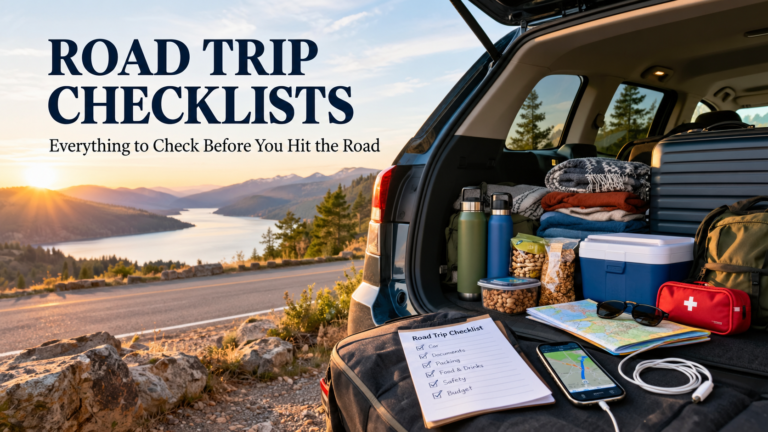
A Simple Long-Distance Road Trip Checklist
Before You Leave
- Confirm your route
- Calculate total distance
- Estimate fuel costs
- Plan major fuel stops
- Book necessary accommodation
- Check weather and road conditions
- Inspect tires
- Check fluids and lights
- Confirm insurance and vehicle documents
- Pack food and water
- Set aside emergency money
- Charge phones and navigation devices
During the Trip
- Take regular breaks
- Monitor fuel level
- Check weather updates
- Adjust the route when necessary
- Keep receipts if tracking expenses
- Avoid driving when excessively tired
- Review the next day’s route before going to bed
FAQ About Long-Distance Road Trip Planning
Final Thoughts
Good long-distance road trip planning isn’t about creating a rigid schedule where nothing can change. It’s about understanding the major costs, knowing your route, preparing your vehicle, and leaving enough time and money for things that don’t go according to plan.
Start with your total mileage, calculate your estimated fuel requirement, plan realistic driving days, price your accommodation and food, then add tolls, parking, activities, and an emergency buffer.
Before you leave, take one final look at your route, vehicle, weather, documents, and budget. You’ll be much better prepared to enjoy the road instead of spending the entire trip trying to solve problems you could have anticipated.