 DriveQuest
How Much Gas Do You Need for a Road Trip?
Wondering how much gas you need for a road trip before you hit the highway? The answer depends mainly on your total driving distance, your vehicle’s fuel economy, and the price you pay for gas.
The good news is that you don’t need complicated math. With your trip mileage and your vehicle’s MPG, you can estimate the number of gallons you’ll need and turn that number into a realistic fuel budget.
In this guide, I’ll show you how to calculate gas for a road trip, explain the difference between one-way and round-trip mileage, and cover the real-world factors that can make your fuel use higher than expected.
How Do You Calculate How Much Gas You Need for a Road Trip?
The basic formula is simple:
Gas needed = Total trip miles ÷ Vehicle MPG
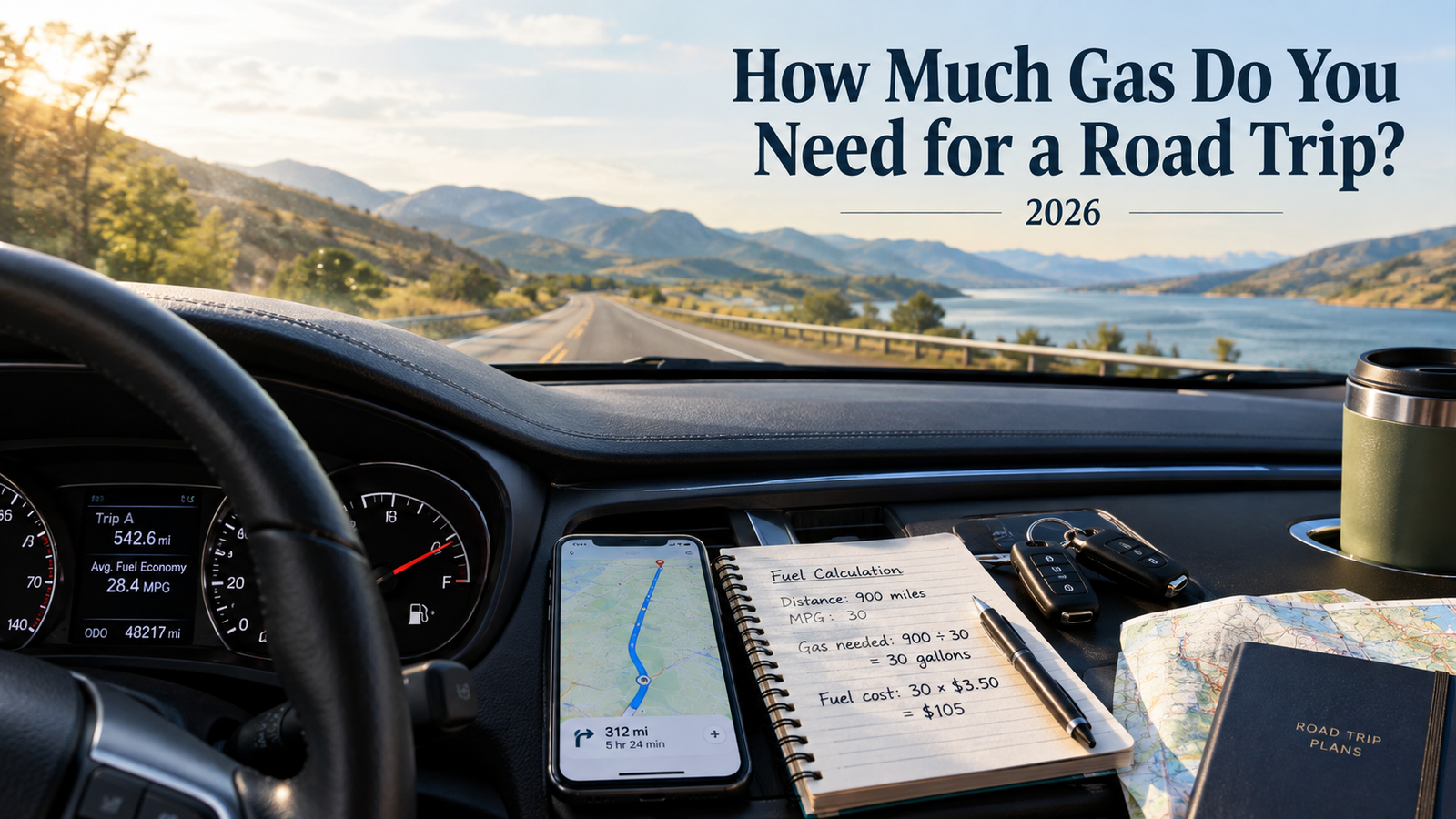
For example, suppose your road trip is 900 miles and your car gets 30 MPG.
900 ÷ 30 = 30 gallons
You would need approximately 30 gallons of gas for the trip under those conditions.
If gas costs $3.50 per gallon, the estimated fuel cost would be:
30 gallons × $3.50 = $105
So your estimated gas cost would be $105.
Keep in mind that this is an estimate. Your actual fuel use can change because of traffic, weather, speed, passengers, luggage, hills, detours, and the type of driving you do.
Road Trip Gas Calculator Formula
You can calculate your fuel needs with these two formulas:
Fuel needed = Total distance ÷ MPG
Then:
Fuel cost = Fuel needed × Price per gallon
Here’s the calculation step by step:
| Trip Distance | Vehicle MPG | Gas Needed |
|---|---|---|
| 300 miles | 30 MPG | 10 gallons |
| 600 miles | 30 MPG | 20 gallons |
| 900 miles | 30 MPG | 30 gallons |
| 1,200 miles | 30 MPG | 40 gallons |
| 1,500 miles | 30 MPG | 50 gallons |
These figures assume the vehicle consistently gets 30 MPG.
Example: 1,200-Mile Road Trip
Let’s say you’re planning a 1,200-mile road trip in a vehicle that averages 25 MPG.
First, calculate the fuel required:
1,200 ÷ 25 = 48 gallons
If the gas price you use for your budget is $3.50 per gallon:
48 × $3.50 = $168
Your estimated fuel budget would therefore be $168.
The $3.50 gas price in this example is only an illustration. Actual prices vary by location and date, so use current prices along your route when creating your final budget.
Don’t Forget the Return Trip
One of the easiest mistakes is calculating only the distance from home to your destination.
If you’re coming back by car, you need to include the return journey.
For example:
- Home to destination: 500 miles
- Destination to home: 500 miles
- Total driving distance: 1,000 miles
If your vehicle gets 25 MPG:
1,000 ÷ 25 = 40 gallons
At an example gas price of $3.50 per gallon:
40 × $3.50 = $140
So don’t automatically use the mileage shown for the outbound route as your total road trip mileage.
What If You Have Several Stops?
Your actual road trip mileage can be considerably higher than the distance between your starting point and final destination.
You might drive:
- 400 miles to your destination
- 50 miles sightseeing
- 30 miles to restaurants and stores
- 70 miles visiting attractions
- 400 miles home
That gives you 950 total miles, not 800.
For a more realistic fuel estimate, add the miles you expect to drive during the trip itself.
A good approach is to plan your major stops first, then estimate the additional local driving you’ll do.
How Much Gas Do You Need Based on MPG?
Fuel economy makes a major difference in how much gas your road trip requires.
Here’s how the same 1,000-mile trip looks with different vehicles:
| Vehicle MPG | Distance | Estimated Gas Needed |
|---|---|---|
| 15 MPG | 1,000 miles | 66.7 gallons |
| 20 MPG | 1,000 miles | 50 gallons |
| 25 MPG | 1,000 miles | 40 gallons |
| 30 MPG | 1,000 miles | 33.3 gallons |
| 35 MPG | 1,000 miles | 28.6 gallons |
| 40 MPG | 1,000 miles | 25 gallons |
This is why knowing your vehicle’s real-world fuel economy is more useful than guessing based on the size of the fuel tank.
How to Find Your Car’s MPG
You can usually find your vehicle’s advertised fuel economy in the owner’s manual, manufacturer’s information, or vehicle specifications.
But your actual MPG may differ from the advertised figure.
For a more realistic estimate, calculate your own MPG:
Miles driven ÷ gallons used = actual MPG
For example, if you drove 360 miles and used 12 gallons:
360 ÷ 12 = 30 MPG
If you have several fill-ups, you can track them over time and use the average rather than relying on one tank.
Why Your Real-World MPG May Be Different
Your fuel economy can change because of:
- Highway versus city driving
- Traffic and frequent stops
- Driving speed
- Hills and mountain roads
- Heavy luggage
- Number of passengers
- Cold or hot weather
- Strong winds
- Tire condition and inflation
- Vehicle maintenance
- Frequent idling
For that reason, using a slightly conservative MPG estimate can give you a more practical fuel budget.
Highway MPG vs. City MPG
Road trips often involve a lot of highway driving, but don’t assume every mile will be highway mileage.
You might spend most of your journey on highways and then use your vehicle in cities, towns, parking areas, and tourist destinations.
If your trip involves substantial city driving, your overall MPG may be lower than your highway figure.
For budgeting, consider the type of driving you’ll actually be doing instead of automatically using the highest MPG number available for your vehicle.
How Much Gas Should You Budget for a Road Trip?
Once you know your estimated fuel consumption, you can create a fuel budget.
Here’s an example for a 1,500-mile road trip:
- Vehicle fuel economy: 30 MPG
- Total distance: 1,500 miles
- Example gas price: $3.50 per gallon
First:
1,500 ÷ 30 = 50 gallons
Then:
50 × $3.50 = $175
Your estimated fuel cost is $175.
However, I would not treat $175 as the exact amount you’ll spend. If your route includes detours, traffic, local driving, or higher gas prices, your final cost could be different.
Add a Fuel Buffer to Your Estimate
It’s smart to leave some room in your budget rather than planning your fuel spending down to the last dollar.
For example, if your initial calculation says you’ll spend about $175, you could set aside additional money for unexpected mileage or changes in fuel prices.
A fuel buffer can help cover:
- Unplanned detours
- Extra sightseeing
- Traffic-related fuel consumption
- Local driving
- Route changes
- Higher-than-expected gas prices
You don’t necessarily need a huge extra amount. The goal is simply to avoid making your budget so tight that a small change creates a problem.
How Many Gallons Does a Road Trip Use?
There isn’t one universal answer because road trips vary dramatically in distance and vehicle efficiency.
For a quick estimate:
| Road Trip Distance | 20 MPG | 25 MPG | 30 MPG | 35 MPG |
|---|---|---|---|---|
| 500 miles | 25 gal | 20 gal | 16.7 gal | 14.3 gal |
| 1,000 miles | 50 gal | 40 gal | 33.3 gal | 28.6 gal |
| 1,500 miles | 75 gal | 60 gal | 50 gal | 42.9 gal |
| 2,000 miles | 100 gal | 80 gal | 66.7 gal | 57.1 gal |
These are mathematical estimates based on constant MPG. Your actual fuel consumption may be higher or lower.
How Far Can You Drive on One Tank?
Your vehicle’s fuel tank size also matters when planning fuel stops.
The basic calculation is:
Driving range = Tank capacity × MPG
For example, if your vehicle has a 15-gallon tank and averages 30 MPG:
15 × 30 = 450 miles
That gives a theoretical range of about 450 miles per full tank.
In real-world driving, you shouldn’t plan to use every drop of fuel. Weather, traffic, detours, and other conditions can reduce your practical range.
It’s better to identify fuel stations along longer stretches of your route, particularly in unfamiliar or remote areas.
How Often Should You Stop for Gas on a Road Trip?
There isn’t a single mileage rule that works for every vehicle.
Your fuel stops depend on:
- Your fuel tank size
- Your actual MPG
- Fuel availability along the route
- How comfortable you are with a lower fuel level
- Road conditions
- Whether you’re traveling through remote areas
Instead of waiting until the tank is nearly empty, check upcoming fuel options when you still have plenty of range available.
This becomes particularly important when traveling through rural areas where the next fuel station may be farther away than expected.
How to Save Gas on a Road Trip
You don’t need extreme driving techniques to reduce unnecessary fuel consumption.
A few ordinary habits can help you use your fuel more efficiently.
1. Keep Your Tires Properly Inflated
Check your tire pressure before leaving and follow the vehicle manufacturer’s recommended pressure.
Don’t inflate tires beyond the recommended level simply to try to save fuel.
2. Avoid Unnecessary Detours
A small detour might not seem important, but several unnecessary drives can add a surprising number of miles to a long trip.
Group nearby attractions and errands together when possible.
3. Pack Snacks and Drinks
Stopping frequently for food can add extra driving and spending.
Packing some snacks and drinks can make the trip easier and reduce the need for unnecessary stops.
4. Drive Smoothly
Frequent hard acceleration and braking can increase fuel consumption.
Smooth, predictable driving is generally more practical for long-distance travel and can make the journey less tiring.
5. Compare Fuel Prices Along Your Route
Gas prices can differ between locations.
When planning a long trip, check current fuel prices along your route and avoid assuming that every station will charge the same amount.
Just don’t make a large detour solely to save a small amount on fuel. The extra miles can cancel out the savings.
6. Combine Stops
If you need fuel, food, groceries, and a bathroom break, consider handling them during the same stop.
This can save time and prevent unnecessary back-and-forth driving.
What Can Increase Your Road Trip Fuel Use?
Your estimated fuel requirement may increase if conditions are different from what you expected.
Heavy Vehicle Load
A car packed with passengers, luggage, camping equipment, or other heavy items may use more fuel than when lightly loaded.
Only bring what you actually need.
Mountain Roads
Steep climbs can increase fuel consumption, particularly when combined with heavy loads and frequent changes in speed.
Your route may also be longer than a simple map-distance calculation suggests.
Bad Weather
Strong winds, heavy rain, snow, or extreme temperatures can affect driving conditions and fuel consumption.
Weather can also cause you to take longer routes or make additional stops.
Traffic
Stop-and-go traffic generally requires more fuel than steady highway driving.
If your route passes through major cities, consider whether your mileage estimate accounts for local driving and congestion.
Don’t Budget for Fuel Alone
Fuel is an important road trip expense, but it isn’t the entire cost of traveling by car.
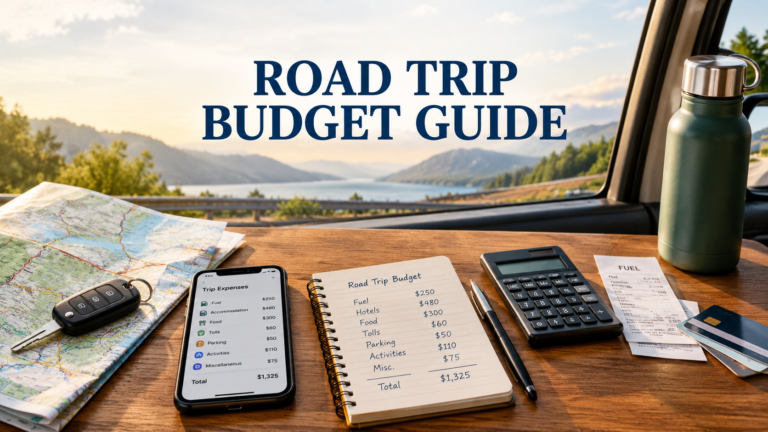
A realistic road trip budget may also include:
| Expense | Example Budget |
|---|---|
| Fuel | $175 |
| Accommodation | $300 |
| Food | $200 |
| Tolls | $50 |
| Parking | $50 |
| Activities | $100 |
| Emergency/Miscellaneous Buffer | $100 |
| Estimated Total | $975 |
These numbers are illustrative only, not universal road trip prices.
Accommodation, food, tolls, parking, activities, and fuel prices can vary significantly depending on your destination, travel dates, vehicle, and personal choices.
The important point is to include these categories instead of assuming your fuel calculation represents the full cost of the trip.
Common Road Trip Gas and Budgeting Mistakes
Forgetting the Return Trip
A 600-mile destination doesn’t necessarily mean a 600-mile road trip.
If you’re driving home, your fuel calculation needs to include those return miles.
Ignoring Local Driving
Sightseeing, restaurants, attractions, and errands all add mileage.
Include reasonable local driving in your estimate.
Using the Best Possible MPG
If your car sometimes gets 35 MPG but normally averages closer to 30 MPG on loaded road trips, budgeting around 35 MPG may leave you short.
Use a realistic figure.
Forgetting Fuel Price Differences
Gas prices can vary between locations and change over time.
Use current route-specific prices when you’re finalizing your budget rather than treating an old average as a guaranteed price.
Spending Your Entire Fuel Budget
Unexpected mileage happens.
Leaving some flexibility in your budget is better than assuming the first calculation will be perfectly accurate.
Driving Too Far Between Fuel Stops
Saving a few minutes by skipping a fuel stop isn’t worth creating unnecessary stress, especially on unfamiliar or remote roads.
Plan fuel stops around your vehicle’s practical range and the availability of stations.
A Simple Road Trip Gas Calculation You Can Reuse
Before your next trip, follow these five steps:
Step 1: Calculate Total Miles
Add:
Outbound distance + return distance + estimated local driving
Step 2: Find Your Realistic MPG
Use your vehicle’s typical fuel economy rather than an overly optimistic number.
Step 3: Calculate Gallons
Total miles ÷ MPG = gallons needed
Step 4: Estimate Fuel Cost
Gallons needed × current estimated gas price = fuel cost
Step 5: Add a Buffer
Set aside some additional money for unexpected mileage, traffic, detours, or changes in fuel prices.
That’s it. You now have a much more useful estimate of your road trip fuel needs.
Frequently Asked Questions
Final Takeaway
The simplest answer is:
Total road trip miles ÷ your vehicle’s MPG = estimated gallons of gas needed.
Then multiply those gallons by the current gas price you’re budgeting for.
For example, a 900-mile trip in a vehicle averaging 30 MPG requires about 30 gallons. At an illustrative price of $3.50 per gallon, that would be about $105 in fuel.
Before you leave, calculate your full driving distance, include local miles and the return trip, use a realistic MPG figure, check current fuel prices along your route, and keep some extra room in your budget.
That five-minute calculation can make your overall road trip budget much easier to manage.