 DriveQuest
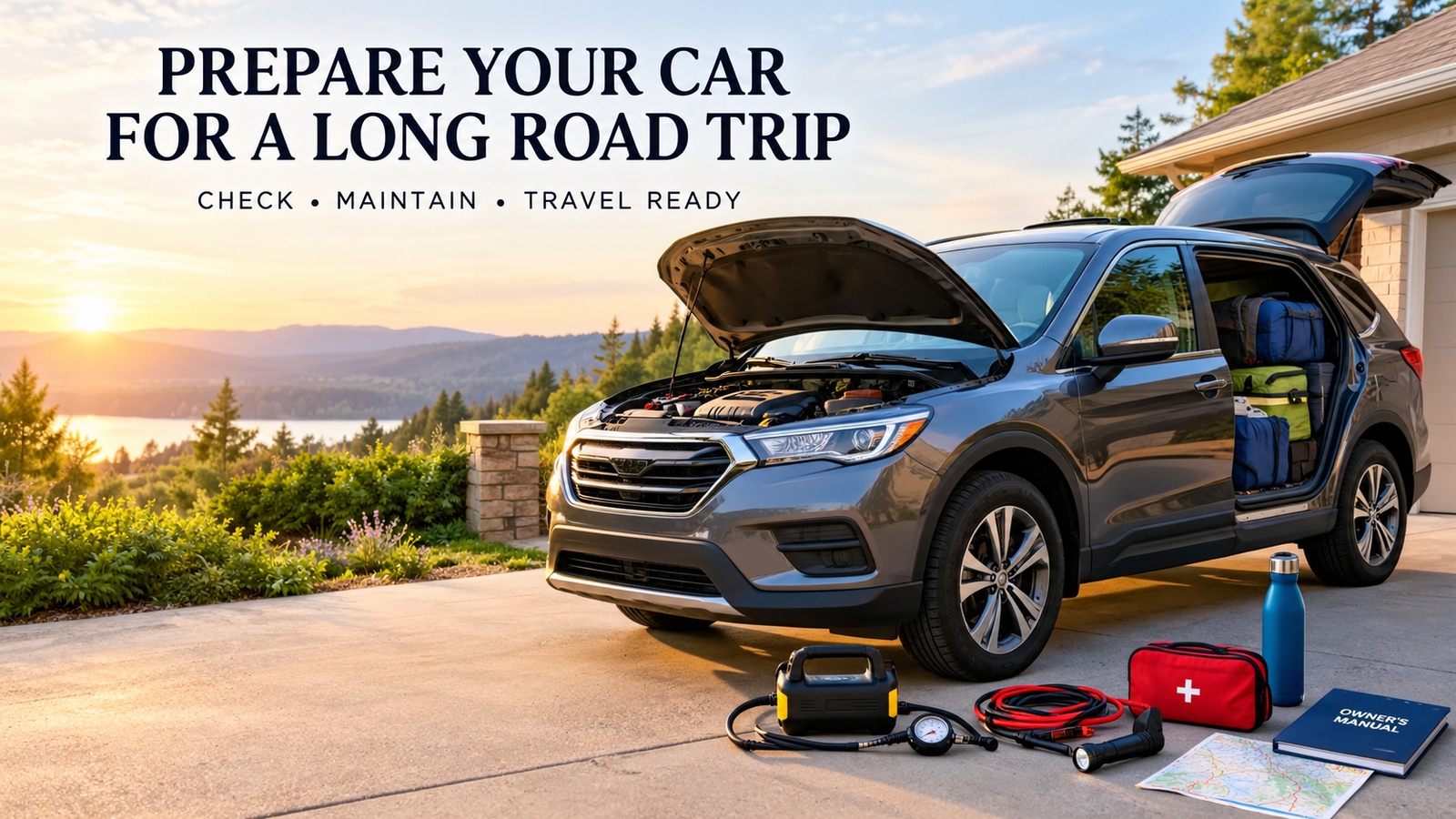
How to Prepare Your Car for a Long Road Trip
A long road trip can be exciting, but the experience can change quickly if your car develops a problem hundreds of miles from home.
The good news is that you do not need to be a car expert to prepare your vehicle properly. A few checks before departure can help you catch worn tires, low fluids, weak batteries, lighting problems, and other issues before they become expensive roadside problems.
In this guide, you’ll learn how to prepare your car for a long road trip, what to inspect yourself, when to visit a mechanic, what emergency equipment to carry, and how to create a simple pre-trip car checklist.
Why Car Preparation Matters Before a Long Road Trip
Your vehicle may handle everyday driving perfectly well but still need attention before a long-distance trip.
A road trip often means several hours of continuous driving, additional passengers and luggage, changing weather, highway speeds, and longer distances between familiar repair shops.
The goal is not to make your car perfect. It is to make sure the important systems are in good condition and that you know about potential problems before leaving.
NHTSA recommends checking tire pressure before long road trips and regularly maintaining items such as fluids, lights, batteries, and other basic vehicle components.
How to Prepare Your Car for a Long Road Trip
Start your preparation several days before departure rather than waiting until the night before.
This gives you enough time to fix a problem if your inspection reveals something that needs professional attention.
A useful approach is to divide your preparation into four areas:
- Safety checks
- Maintenance checks
- Emergency preparation
- Loading and final inspection
Let’s go through each one.
1. Check Your Tires Carefully
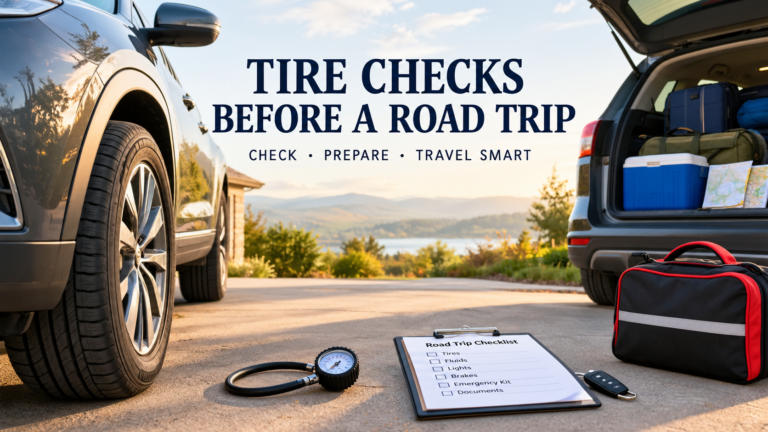
Your tires deserve special attention before a long road trip because they are your main contact with the road.
Check all four tires for:
- Correct air pressure
- Uneven tread wear
- Cuts or cracks
- Bulges
- Punctures
- Objects stuck in the tread
- Unusual wear on the edges
- Visible damage to the sidewalls
Also check the spare tire if your vehicle has one.
NHTSA recommends checking tire pressure when the tires are cold and using the vehicle manufacturer’s recommended pressure found on the driver’s door placard or in the owner’s manual. The number molded into the tire sidewall is not the recommended vehicle pressure.
Check Tire Pressure When Cold
For the most accurate reading, check your tires after the vehicle has been parked for several hours.
Do not simply add air based on how a tire looks. A tire can be significantly underinflated without looking obviously flat.
If your vehicle is heavily loaded for a trip, check your owner’s manual for any manufacturer-specific guidance regarding tire pressure and maximum vehicle loading.
Don’t Ignore Uneven Tire Wear
Uneven wear can indicate an alignment, suspension, inflation, or other maintenance issue.
If you notice unusual wear, vibration, repeated pressure loss, cracks, bulges, or other damage, have the tire inspected by a qualified professional before starting a long trip. NHTSA specifically recommends professional attention when tire damage is found.
2. Inspect the Brakes
Brakes are not something you want to discover problems with halfway through a trip.
Before leaving, pay attention to symptoms such as:
- Squealing or grinding
- Vibrations when braking
- A brake pedal that feels unusually soft
- Pulling to one side while braking
- Longer stopping distances
- Warning lights on the dashboard
If you already know your brake pads, rotors, or other brake components are near the end of their service life, don’t postpone the repair simply because the car is still driveable.
A long trip can put considerably more use on the braking system than your normal daily commute.
3. Check the Engine Oil
Check your oil level according to the instructions in your owner’s manual.
If an oil change is due or nearly due, consider having it completed before departure rather than waiting until you are away from home.
Use the oil grade recommended by your vehicle manufacturer.
NHTSA recommends changing oil according to the owner’s manual and checking relevant fluid levels as part of routine vehicle maintenance.
Should You Carry Extra Engine Oil?
If your vehicle normally consumes some oil between changes, carrying a small amount of the correct oil can be useful.
Do not assume every vehicle uses the same oil. Check your owner’s manual first.
4. Check Coolant and the Cooling System
Overheating can turn a comfortable road trip into a roadside repair.
Before departure, check the coolant level and look for obvious signs of leakage.
Pay attention to:
- Low coolant
- Wet spots under the vehicle
- Coolant residue around hoses or connections
- An overheating warning
- Temperature gauge behaving unusually
- Damaged or deteriorated hoses
NHTSA recommends checking the cooling system for leaks and ensuring coolant meets the manufacturer’s specifications.
Never open a hot cooling system. If the engine has overheated, allow it to cool and follow the vehicle manufacturer’s instructions.
5. Check Other Important Fluids
Your car has more fluids than just engine oil and coolant.
Depending on your vehicle, check:
- Brake fluid
- Transmission or clutch fluid
- Power steering fluid
- Windshield washer fluid
- Coolant
Not every vehicle has all of these fluids in the same form or location, so use the owner’s manual as your guide.
If you notice a fluid level repeatedly dropping or find a leak, get it checked rather than simply topping it off and hoping the problem disappears.
NHTSA specifically advises checking fluid levels and having leaks serviced.
6. Test the Battery
A weak battery can leave you stranded even when everything else seems fine.
Look for signs such as:
- Slow engine cranking
- Difficulty starting
- Corrosion around battery terminals
- Flickering electrical components
- Battery warning lights
- A battery that is approaching the end of its expected service life
If you’re unsure about the battery’s condition, have a mechanic test the battery and charging system before the trip.
NHTSA recommends having the battery and charging system checked and repairing or replacing them when necessary.
7. Check All Exterior Lights
Walk around the vehicle and test:
- Headlights
- High beams
- Brake lights
- Turn signals
- Hazard lights
- Reverse lights
- Parking lights
Ask another person to operate the controls while you inspect the lights if possible.
Also clean dirty headlights, windows, mirrors, and windshields. Clear visibility matters even more when driving unfamiliar roads at night or in poor weather.
NHTSA recommends routinely checking headlights, brake and parking lights, reverse lights, and turn signals.
8. Inspect the Windshield Wipers
Worn wipers may not seem important on a sunny day, but that changes when you encounter heavy rain.
Replace wipers if they:
- Leave large streaks
- Skip across the glass
- Make excessive noise
- Leave areas uncleared
Top up windshield washer fluid as well.
It’s a small preparation step that can make a major difference during unexpected weather.
9. Check Belts and Hoses
Look under the hood for obvious signs of deterioration.
Pay attention to belts and hoses that show:
- Cracks
- Cuts
- Bulges
- Blisters
- Severe wear
- Leaking connections
Do not attempt complicated repairs yourself unless you know exactly what you’re doing.
NHTSA specifically recommends inspecting belts and hoses for signs of deterioration before road trips.
10. Check Your Car’s Maintenance Schedule
Your owner’s manual is one of the most useful resources when preparing your car for a long road trip.
Look at the maintenance schedule and check whether you’re approaching a service interval.
Depending on the vehicle, upcoming maintenance may involve:
- Oil and filter replacement
- Tire rotation
- Brake inspection
- Air filter replacement
- Transmission service
- Spark plugs
- Battery inspection
- Cooling-system service
You don’t necessarily need to perform every maintenance item immediately before a trip.
The important point is to avoid ignoring maintenance that is already due.
11. Check for Recalls
Before a long trip, check whether your vehicle has an outstanding safety recall.
For vehicles in the United States, NHTSA provides a VIN-based recall lookup. If a recall applies to your vehicle, follow the manufacturer’s instructions and arrange the repair when appropriate.
If you’re traveling in another country, check the relevant government or manufacturer recall resources for your vehicle.
12. Test the Air Conditioning and Heating
Temperature control is more than a comfort issue during a long journey.
Test your:
- Air conditioning
- Heater
- Defroster
- Cabin fan
- Climate-control settings
This is especially important if your route could involve very hot or very cold weather.
If the air conditioning suddenly stops working on a long trip, finding a repair shop at the right time may be inconvenient and expensive.
13. Make Sure Your Spare Tire and Jack Are Ready
Having a spare tire is only helpful if you can actually use it.
Before departure, find:
- Spare tire
- Jack
- Lug wrench
- Wheel-lock key, if applicable
- Jacking-point information
- Tire-pressure gauge
If your vehicle uses a temporary spare, understand its limitations before you need it.
Some modern vehicles don’t include a traditional spare and may instead have a tire repair kit or inflator. Know which system your car has.
14. Pack a Basic Road Trip Emergency Kit
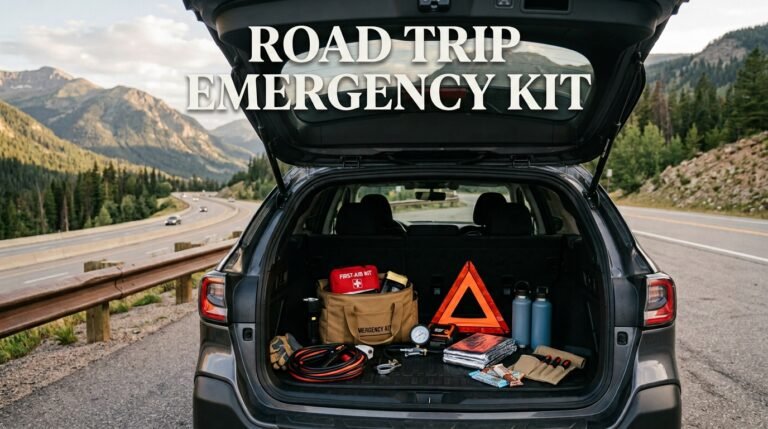
You don’t need to fill your trunk with equipment, but a few basic items can be useful.
Basic Car Emergency Kit
- Tire-pressure gauge
- Portable tire inflator
- Jumper cables or approved jump starter
- Flashlight
- Reflective warning device
- Basic first-aid kit
- Work gloves
- Phone charger
- Water
- Basic tools appropriate for your vehicle
- Spare fuses if your vehicle uses replaceable fuses
- Vehicle owner’s manual
Your exact equipment should depend on your vehicle, route, weather, and level of mechanical knowledge.
Don’t carry equipment you don’t know how to use simply because someone recommended it online.
15. Check Your Insurance and Roadside Assistance
Before leaving, make sure you know what assistance is available if something goes wrong.
Check your:
- Auto insurance information
- Roadside assistance membership
- Emergency contact information
- Towing coverage
- Rental-car coverage, if applicable
Save important phone numbers somewhere accessible.
If your roadside assistance has mileage limits or other conditions, understand them before the trip rather than during a breakdown.
16. Don’t Overload the Vehicle
A fully packed vehicle can affect handling, braking, comfort, and fuel consumption.
Before loading everything into the trunk, ask whether you really need each item.
Keep heavier items low and secure loose luggage so it cannot move around during sudden braking.
NHTSA advises drivers to properly secure loads because unsecured items can create hazards for occupants and other road users.
Also stay within the vehicle’s specified passenger and cargo limits.
17. Take a Short Test Drive
If you’ve completed major maintenance or haven’t driven the vehicle for a long distance recently, take it for a short test drive before departure.
Pay attention to:
- Steering
- Braking
- Tire vibration
- Engine temperature
- Unusual sounds
- Warning lights
- Transmission behavior
- Air conditioning
A short local drive gives you an opportunity to discover a problem while you’re still close to home.
18. When Should You Take Your Car to a Mechanic?
You don’t need a mechanic to perform every basic check.
However, professional inspection makes sense when:
- A warning light is on
- The car overheats
- Brakes feel abnormal
- Tires are damaged
- The vehicle pulls to one side
- You hear unusual mechanical noises
- You smell burning or leaking fluid
- The battery struggles to start the vehicle
- Maintenance is overdue
- You don’t know the vehicle’s maintenance history
If you have doubts about a safety-critical component, getting professional advice is usually better than guessing.
A Simple Long Road Trip Car Preparation Checklist
Use this checklist a few days before departure:
| Check | What to Look For |
|---|---|
| Tires | Pressure, tread, damage, uneven wear |
| Spare tire | Pressure, condition, accessibility |
| Brakes | Noise, vibration, unusual pedal feel |
| Engine oil | Correct level and service interval |
| Coolant | Correct level and visible leaks |
| Other fluids | Brake, transmission, steering, washer fluid |
| Battery | Starting performance and visible corrosion |
| Lights | Headlights, brake lights, signals, reverse lights |
| Wipers | Smooth operation and clear visibility |
| Belts & hoses | Cracks, cuts, bulges, deterioration |
| A/C & heater | Proper operation |
| Recalls | Check applicable recall resources |
| Emergency kit | Jumper equipment, inflator, flashlight, etc. |
| Documents | Insurance, registration, roadside assistance |
| Cargo | Secure and within vehicle limits |
How Much Can Car Preparation Cost?
The cost depends heavily on the condition of your vehicle.
A basic inspection may cost little or nothing if you perform simple checks yourself, while replacing tires, brakes, a battery, or other components can cost substantially more.
Instead of creating a fixed “road trip maintenance budget,” make a short list of possible expenses based on your vehicle’s actual condition.
For example:
| Possible Expense | Example Budget Approach |
|---|---|
| Tire inspection | Check local shop pricing |
| Oil change | Check current local price |
| Wiper replacement | Check vehicle-specific price |
| Battery test | Ask local service center |
| Tire replacement | Get quotes if needed |
| Brake service | Get an inspection and written estimate |
| Emergency supplies | Set a small equipment budget |
| Unexpected repair | Keep a separate buffer |
These are planning categories, not guaranteed prices. Actual costs vary by vehicle, location, parts, labor rates, and the repairs required.
How Car Preparation Can Reduce Road Trip Costs
Vehicle preparation isn’t only about safety.
A poorly maintained vehicle can also create unexpected expenses during a trip.
For example, discovering a tire problem before departure gives you time to compare replacement options locally. Discovering the same problem late at night in an unfamiliar area gives you fewer choices.
You can also reduce unnecessary fuel costs by keeping your tires at the manufacturer’s recommended pressure and avoiding excessive cargo. NHTSA notes that proper tire maintenance affects fuel consumption as well as tire durability.
The goal isn’t to spend money on maintenance you don’t need. It’s to identify genuine problems early, when you have more time and choices.
Common Mistakes When Preparing a Car for a Road Trip
Only Checking the Fuel Tank
A full tank doesn’t mean the vehicle is ready for a 1,000-mile journey.
Tires, brakes, fluids, battery, lights, and maintenance schedules also deserve attention.
Checking Tires by Looking at Them
A tire can look normal while having incorrect pressure.
Use a reliable tire-pressure gauge and compare the reading with the vehicle manufacturer’s recommended pressure.
Waiting Until the Morning of Departure
If you discover a weak battery or damaged tire at 6 a.m. on departure day, you may have very few options.
Start your inspection several days ahead.
Ignoring Small Warning Signs
A strange vibration, warning light, fluid leak, or unusual noise shouldn’t automatically be dismissed because the vehicle still drives.
Small problems can become much more inconvenient when you’re far from home.
Packing Too Much
More luggage isn’t always better.
Excess cargo takes up space and can affect how the vehicle handles. Pack what you actually need and secure everything properly.
Assuming a Recent Oil Change Means Everything Is Fine
An oil change doesn’t automatically check every important component.
Your vehicle may still need tire, brake, battery, fluid, lighting, and other inspections.
Frequently Asked Questions
Final Thoughts
Learning how to prepare your car for a long road trip doesn’t require advanced mechanical knowledge.
Start with the things that matter most: tires, brakes, fluids, battery, lights, cooling system, and scheduled maintenance. Then make sure your spare tire or repair equipment, emergency supplies, documents, and luggage are ready.
The best time to discover a vehicle problem is before you leave, when you still have time to deal with it.
Before starting your trip, take a final walk around the vehicle, check the tires and lights, secure your luggage, and make sure you have the equipment and information you may need.
A few minutes of preparation can give you something valuable on a long drive: fewer surprises and more confidence on the road.