 DriveQuest

How to Plan a Weekend Road Trip From Start to Finish
A weekend road trip sounds simple: pick a destination, get in the car, and go. But without a little planning, a short trip can quickly turn into expensive hotels, rushed driving, missed stops, and a budget that disappears faster than expected.
Learning how to plan a weekend road trip from start to finish can help you enjoy the trip without overplanning every minute. The key is to choose a realistic destination, estimate your costs, prepare your vehicle, plan a flexible route, and leave enough room for unexpected delays.
This guide walks you through the entire process, from choosing where to go to getting home safely.
1. Start by Choosing the Right Weekend Road Trip
The first step is deciding how far you actually want to drive.
For a weekend trip, the destination should leave enough time for you to enjoy the place rather than spending most of Saturday and Sunday behind the wheel.
Before choosing a destination, consider:
- How many hours you are comfortable driving
- Whether you are traveling alone or with passengers
- Your departure time on Friday
- Your return time on Sunday
- Weather and seasonal conditions
- Your vehicle’s fuel economy
- Accommodation costs
- Activities you want to do
A destination that looks close on a map may take much longer once you include traffic, fuel stops, meals, and breaks.
Use a Simple Weekend Rule
Instead of asking, “How far can I drive?” ask:
“How much driving still leaves me enough time to enjoy the destination?”
For example, if you leave Friday afternoon, a destination several hours away may work well. But if you cannot leave until late Friday evening, choosing somewhere closer may give you a much better weekend.
A good weekend road trip should feel like a break, not another endurance test.
2. Decide How Many Days You Actually Have
Write down your available time before making reservations.
A typical weekend road trip might look like this:
| Day | Example Plan |
|---|---|
| Friday | Leave after work, drive to destination |
| Saturday | Explore, relax, activities |
| Sunday | Morning activity, drive home |
| Monday | Normal work or school schedule |
If you have only Saturday and Sunday available, consider staying closer to home.
If you have Friday through Monday, you can comfortably increase the driving distance or add another overnight stop.
Don’t Forget the Drive Home
One of the most common planning mistakes is focusing heavily on the outbound trip and treating the return journey as an afterthought.
If you need to be home Sunday evening, calculate the return driving time before booking Sunday activities.
You do not want to discover at 4 p.m. that your “quick final stop” leaves you facing hours of driving before bedtime.
3. Plan Your Route Before You Leave
Once you know your destination, map out the general route.
You do not necessarily need every minute planned, but you should know:
- Starting point
- Main destination
- Major highways or roads
- Fuel stops
- Rest stops
- Meal stops
- Overnight accommodation
- Planned attractions
- Alternative routes
Navigation apps can help you compare routes, view traffic, and identify stops along the way. Google Maps, for example, provides driving directions, traffic information, route options, and the ability to add stops.
Still, do not blindly follow navigation instructions. Pay attention to road signs, traffic regulations, closures, and changing conditions.
Plan Stops Instead of Driving Nonstop
A road trip becomes much easier when you treat breaks as part of the itinerary.
For a weekend trip, consider stopping for:
- Fuel
- Bathroom breaks
- Meals
- Stretching
- Coffee
- Scenic viewpoints
- Short walks
If you are getting tired, stop rather than trying to “push through” because the destination is close.
4. Check the Weather and Road Conditions
Weather can change your weekend road trip dramatically.
Before leaving, check the forecast for:
- Your departure location
- The route
- Your destination
- The return route
Also look for severe weather, road closures, construction, flooding, snow, or other conditions that could affect your route.
Do not build a schedule so tight that a weather delay ruins the entire weekend.
A flexible itinerary is usually more useful than a perfect itinerary that leaves no room for change.
5. Calculate Your Road Trip Distance
Now calculate your approximate total mileage.
Include:
Outbound distance + local driving + return distance = estimated total mileage
For example:
- Home to destination: 250 miles
- Local driving: 75 miles
- Destination to home: 250 miles
Total estimated distance = 575 miles
Adding local driving is important because you may drive considerably more after reaching your destination.
You might visit restaurants, attractions, viewpoints, nearby towns, or your hotel multiple times.
6. Estimate Your Fuel Cost
Fuel is one of the easiest road trip expenses to estimate if you know your vehicle’s fuel economy.
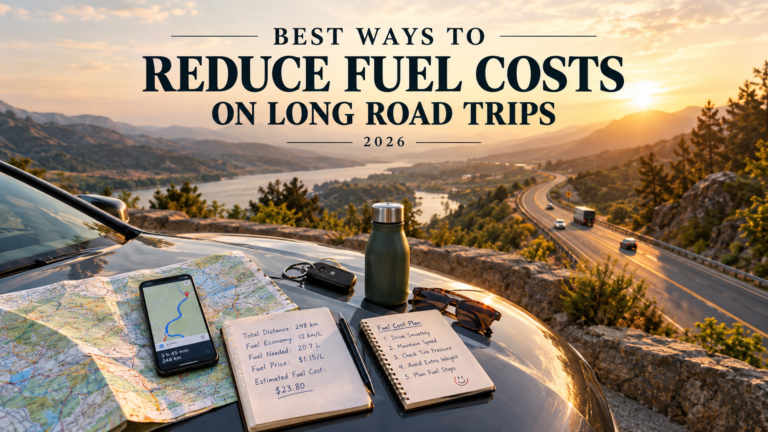
Use this formula:
Fuel needed = Total miles ÷ Vehicle MPG
Then:
Fuel cost = Fuel needed × Price per gallon
Example Fuel Calculation
Suppose your weekend road trip is 575 miles and your vehicle averages 30 MPG.
575 ÷ 30 = 19.17 gallons
If fuel happens to cost $3.50 per gallon along your route:
19.17 × $3.50 = about $67.10
So you could use approximately $67 as a planning estimate.
This is only an example. Actual fuel costs depend on current prices, your vehicle, driving speed, traffic, terrain, weather, vehicle load, and how much driving you do locally.
If your vehicle gets different highway and city mileage, using a conservative estimate can make your budget safer.
7. Build a Complete Weekend Road Trip Budget
Fuel is only one part of the cost.
Your weekend road trip budget may include:
- Fuel
- Hotel or motel
- Food
- Tolls
- Parking
- Attractions
- Rental car costs
- Insurance-related costs
- Snacks and drinks
- Vehicle maintenance
- Emergency expenses
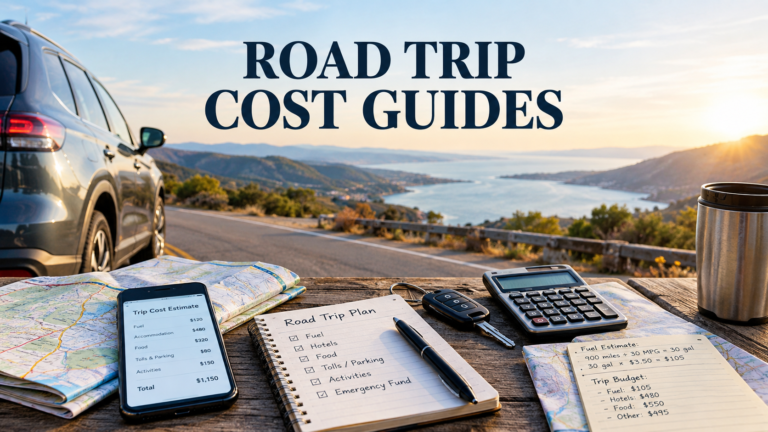
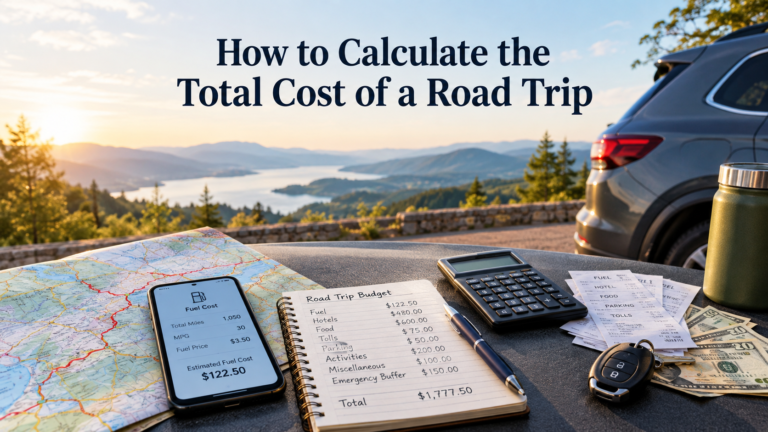
A sample budget might look like this:
| Expense | Example Cost |
|---|---|
| Fuel | $70 |
| Hotel | $180 |
| Food | $120 |
| Tolls | $25 |
| Parking | $30 |
| Activities | $75 |
| Miscellaneous | $40 |
| Emergency buffer | $60 |
| Estimated Total | $600 |
These numbers are illustrative only, not universal weekend road trip prices.
Hotel rates, fuel prices, parking charges, tolls, food prices, and attraction fees can vary significantly by destination and travel date.
Fixed vs Variable Costs
It can also help to divide expenses into two groups.
Fixed or mostly predictable costs:
- Hotel reservation
- Attraction tickets booked in advance
- Rental car
- Certain parking fees
Variable costs:
- Fuel
- Food
- Snacks
- Extra driving
- Unplanned activities
- Additional parking
Knowing the difference helps you understand which costs need advance planning and which ones need a spending limit.
8. Decide How Much to Spend on Accommodation
For a weekend trip, accommodation can become one of your largest expenses.
Before booking, compare:
- Hotel
- Motel
- Vacation rental
- Campground
- Hostel where appropriate
- Staying with family or friends
Do not compare only the advertised nightly price.
Check the total booking cost, including applicable taxes, parking charges, resort or facility fees, and other mandatory charges.
A cheaper room can also become less attractive if it requires expensive parking or adds significant driving time.
Choose Location Carefully
Saving $30 on a hotel may not actually save money if the hotel is far outside your destination and requires an extra hour of driving each day.
Sometimes paying a little more for a convenient location can reduce fuel, parking, and wasted time.
9. Plan Your Food Budget
Food costs can quietly take over a weekend budget.
Before leaving, decide which meals you will:
- Pack
- Buy from a grocery store
- Eat at restaurants
- Get from fast-casual or takeaway places
You do not have to pack every meal to save money.
A practical approach could be:
Friday: Eat before leaving or bring dinner
Saturday: Breakfast at hotel or inexpensive café, lunch on the go, dinner at a restaurant
Sunday: Breakfast, packed snacks, lunch during the return trip
Bring simple snacks and drinks if practical.
This can reduce unnecessary convenience-store purchases while also giving you something to eat when there are limited options along the route.
10. Make a Simple Weekend Itinerary
You do not need to schedule every five minutes.
Instead, identify your must-do activities and leave the rest flexible.
For example:
Friday Evening
- Leave home at 4:00 p.m.
- Fuel stop around 6:00 p.m.
- Dinner around 7:00 p.m.
- Arrive at hotel around 9:00 p.m.
Saturday
- Breakfast
- Main attraction
- Lunch
- Scenic drive
- Free time
- Dinner
Sunday
- Breakfast
- One final activity
- Lunch
- Start return drive
- Fuel stop
- Arrive home
This structure gives you direction without turning your weekend into a strict schedule.
11. Avoid Packing Too Many Activities
A common mistake is trying to see everything during a short trip.
If you arrive Saturday morning and immediately visit six attractions, you may spend more time driving between locations than actually enjoying them.
Choose two or three priorities.
Ask yourself:
“If I could only do three things on this trip, what would they be?”
Plan those first.
Everything else can be optional.
12. Prepare Your Car Before the Trip
Your vehicle is part of your road trip plan, not something to think about the night before.
Before departure, check your:
- Tires and tire pressure
- Spare tire if equipped
- Engine oil
- Coolant
- Brake condition
- Lights
- Windshield wipers
- Battery
- Washer fluid
- Warning lights
AAA recommends checking tire condition and pressure and making sure the vehicle’s maintenance needs are addressed before a road trip.
If your vehicle has an existing mechanical problem or warning light, deal with it before leaving rather than hoping it will survive the weekend.
Check Your Recommended Tire Pressure
Use the vehicle manufacturer’s recommended tire pressure, typically found on the driver’s door-jamb label or in the owner’s manual.
Do not simply use the maximum pressure printed on the tire sidewall as your normal target.
13. Pack a Basic Road Trip Kit
You do not need to pack your entire house.
A basic kit can include:
- Phone charger
- Power bank
- Water
- Snacks
- First-aid supplies
- Flashlight
- Jumper cables or jump starter
- Tire-pressure gauge
- Basic emergency supplies
- Paper or offline copies of important information
- Personal medications
- Weather-appropriate clothing
AAA’s road-trip preparation guidance also recommends carrying useful emergency supplies and keeping important vehicle documents accessible.
If you are traveling somewhere remote, adjust your supplies according to the destination and expected conditions.
14. Organize Your Documents
Before leaving, make sure you have the documents and information you may need.
Depending on your trip, this could include:
- Driver’s license
- Vehicle registration
- Insurance information
- Hotel confirmation
- Attraction reservations
- Rental car documents
- Emergency contacts
- Roadside assistance information
Save important booking details on your phone, but consider keeping essential information accessible offline as well.
Cell service can be unreliable in some areas.
15. Plan Your Fuel Stops
Do not wait until the fuel warning appears before thinking about your next gas station.
Instead, identify several possible fuel stops along the route.
This is particularly useful if you are driving through rural areas where stations may be farther apart.
When comparing fuel prices, remember that the cheapest station is not always worth a long detour.
For example, saving 10 cents per gallon may not be meaningful if you have to drive several extra miles to reach it.
The goal is to reduce unnecessary spending without creating unnecessary driving.
16. Leave Room for Unexpected Costs
Even a well-planned weekend can produce surprise expenses.
You might encounter:
- A higher fuel price
- Unexpected parking fees
- A road detour
- A meal you did not plan for
- A minor vehicle issue
- A last-minute hotel change
- An attraction you decide to visit
This is why an emergency or miscellaneous buffer is useful.
For example, if your planned trip costs $500, you might set aside an additional amount that you do not expect to spend.
The exact buffer depends on your finances, destination, vehicle, and trip length.
The important point is to budget for uncertainty rather than assuming everything will go exactly according to plan.
17. Plan for Safe and Reasonable Driving
A weekend road trip should not require you to drive while exhausted.
Avoid building an itinerary that depends on arriving after you are already tired.
AAA advises planning breaks and avoiding drowsy driving; its road-trip guidance suggests regular breaks rather than trying to complete long stretches without stopping.
Before the trip:
- Get enough sleep
- Avoid driving when seriously fatigued
- Take breaks
- Share driving when appropriate
- Keep distractions under control
- Never drive faster simply to recover lost time
If you become too tired to drive safely, stop somewhere appropriate and rest.
Arriving later is better than turning your weekend into a dangerous situation.
18. Do a Final Check the Night Before
The night before departure, complete a quick checklist.
Road Trip Night-Before Checklist
- Confirm hotel reservation
- Check weather
- Check the route
- Check for major road closures or delays
- Fill or plan your fuel stop
- Charge your phone and power bank
- Pack food and water
- Check tire pressure
- Gather documents
- Pack medications
- Download important information for offline access
- Set out clothes
- Get enough sleep
The goal is to make departure morning simple.
You should not be searching for your charger or trying to find your hotel confirmation five minutes before leaving.
19. Example Weekend Road Trip Plan
Here is a simple example for a two-night weekend trip.
Assume:
- Total driving: 575 miles
- Vehicle economy: 30 MPG
- Example fuel price: $3.50/gallon
- Two hotel nights
- Two travelers
- Several paid and free activities
Estimated Budget
| Category | Example |
|---|---|
| Fuel | $67 |
| Accommodation | $180 |
| Food | $120 |
| Tolls | $25 |
| Parking | $30 |
| Activities | $75 |
| Miscellaneous | $40 |
| Emergency buffer | $60 |
| Total | $597 |
For two travelers:
$597 ÷ 2 = $298.50 per person
Again, this is simply a planning example.
If you choose a more expensive hotel, drive a less fuel-efficient vehicle, eat at restaurants for every meal, or add several paid activities, the total could be much higher.
On the other hand, free attractions, inexpensive accommodation, packed meals, and shorter driving distances can reduce the total.
Common Weekend Road Trip Planning Mistakes
1. Choosing a destination that is too far away
A weekend is short. Spending most of it driving can defeat the purpose of the trip.
2. Budgeting only for fuel
Fuel may be easy to calculate, but hotels, food, parking, tolls, and activities can make up a large part of the total.
3. Forgetting local driving
Your destination mileage is not necessarily your total mileage.
Add the driving you expect to do after arrival.
4. Planning every minute
A packed itinerary leaves little room for traffic, weather, long restaurant waits, or spontaneous stops.
5. Ignoring the return trip
Always calculate how and when you will get home before adding Sunday activities.
6. Skipping vehicle preparation
A basic pre-trip inspection can identify issues before they become inconvenient or expensive.
7. Leaving no emergency money
A zero-buffer budget assumes nothing will go wrong.
Real travel rarely works that perfectly.
8. Driving while exhausted
Saving an hour by continuing when you are dangerously tired is not a worthwhile saving.
How to Save Money on a Weekend Road Trip
You do not need to make your trip uncomfortable to spend less.
Try these practical strategies:
- Choose a destination closer to home
- Compare accommodation before booking
- Travel outside the most expensive dates when possible
- Pack drinks and some snacks
- Combine nearby attractions into one outing
- Avoid unnecessary route detours
- Compare fuel prices along your planned route
- Use free attractions when they fit your interests
- Set a daily spending limit
- Keep an emergency buffer separate from your normal spending money
- Check parking costs before visiting popular areas
The biggest savings often come from planning the expensive parts before you leave.
FAQ
Final Thoughts
Knowing how to plan a weekend road trip from start to finish does not mean creating a rigid itinerary.
It means understanding your available time, choosing a realistic destination, calculating your total driving distance, estimating fuel and other expenses, preparing your vehicle, and leaving enough flexibility for real-world problems.
Before you leave, take five minutes to check your numbers:
Total miles → Fuel estimate → Accommodation → Food → Tolls and parking → Activities → Emergency buffer
Then check the car, review the route and weather, pack the essentials, and get enough rest before driving.
A little preparation can make a short weekend road trip feel much more relaxed—and help you spend your money on the experience rather than on avoidable surprises.