 DriveQuest
Best Road Trip Routes in the USA for First-Time Travelers
Your first road trip should be exciting—not a test of how well you can survive behind the wheel for 12 hours a day.
The best road trip routes in the USA for first-time travelers usually have a good mix of manageable driving distances, interesting stops, reliable services, scenic roads, and enough flexibility to change plans when something unexpected happens.
From California’s Pacific Coast to Utah’s red-rock country and the historic Route 66, the U.S. has road trips for almost every travel style. The key is choosing a route that matches your available time, driving comfort, budget, and season.
This guide covers beginner-friendly routes, suggested trip lengths, major stops, budgeting considerations, and practical tips for planning your first American road trip.
What Makes a Road Trip Route Good for First-Time Travelers?
A beautiful road isn’t automatically a good beginner road trip.
For a first trip, look for a route that offers:
- Manageable daily driving
- Plenty of fuel stations and places to eat
- Regular accommodation options
- Interesting stops along the way
- Roads that don’t require advanced driving skills
- Multiple opportunities to shorten or change the route
- Reasonable access to major towns and cities
- Enough time to enjoy stops instead of constantly watching the clock
You also don’t need to drive the entire length of a famous route.
For example, the Blue Ridge Parkway stretches 469 miles between Shenandoah National Park and Great Smoky Mountains National Park, but the National Park Service specifically notes that travelers can enjoy shorter sections and create loops using nearby highways.
That flexibility is extremely useful when you’re new to road trips.
7 Best Road Trip Routes in the USA for First-Time Travelers
Here are seven routes worth considering for a first major road trip.
| Route | Suggested Time | Best For | Driving Style |
|---|---|---|---|
| California Highway 1 | 3–7 days | Coast & scenery | Scenic |
| Blue Ridge Parkway | 3–6 days | Mountains & small towns | Relaxed |
| Utah Mighty 5 | 5–10 days | National parks | Adventure |
| Historic Route 66 | 7–14+ days | History & Americana | Long-distance |
| Florida Keys Overseas Highway | 2–4 days | Beaches & ocean views | Easy |
| New England scenic loop | 4–7 days | Fall foliage & towns | Flexible |
| Glacier–Grand Teton route | 5–10 days | Mountains & wildlife | Seasonal |
These aren’t ranked from “best” to “worst.” Each route works for a different kind of first-time traveler.
1. California Highway 1: Pacific Coast Road Trip
Best for: Ocean views, beaches, coastal towns, photography, and a relatively simple point-to-point trip.
California’s Highway 1 is one of the most recognizable scenic drives in the country. The highway extends for more than 650 miles between Dana Point and Leggett, with the Central Coast and Big Sur providing some of the most famous scenery.
For a first road trip, however, you don’t need to drive the entire highway.
A beginner-friendly route
Consider:
San Francisco → Monterey → Big Sur → San Luis Obispo → Santa Barbara → Los Angeles
You can make this a 3–5 day trip if you’re focused on major stops, or stretch it to a week if you want more beach and hiking time.
Big Sur is particularly scenic, with rugged coastline, cliffs, redwoods, and ocean views along Highway 1.
Why it’s good for beginners
You can easily build the trip around towns where you’ll find:
- Hotels and motels
- Restaurants
- Fuel
- Grocery stores
- Scenic viewpoints
- Rental-car services
- Alternative routes
One important point: Highway 1 is a scenic road, not a road to rush through.
California’s official travel site reported that Highway 1 through Big Sur was fully open again as of January 14, 2026, but recommends checking Caltrans’ current conditions before traveling.
Budget tip
Coastal accommodation can become one of the biggest expenses. Consider staying slightly inland rather than paying premium prices directly on the coast.
2. Blue Ridge Parkway: Virginia to North Carolina
Best for: Mountain scenery, relaxed driving, overlooks, hiking, and travelers who don’t want to drive huge distances every day.
The Blue Ridge Parkway connects Shenandoah National Park in Virginia with Great Smoky Mountains National Park in North Carolina.
It’s 469 miles long, but you don’t have to complete the entire route.
A simple beginner approach
Instead of treating the parkway like a race, choose a section such as:
Roanoke → Blue Ridge Parkway → Asheville → Great Smoky Mountains
Or create a shorter loop from one of the major highway access points.
The National Park Service says roughly 30 miles on the Parkway can take about an hour, with a maximum speed limit of 45 mph and often lower speeds.
That’s an important planning lesson: scenic mileage isn’t the same as interstate mileage.
Important fuel warning
There are no gas stations directly on the Blue Ridge Parkway, although stations are available near access points.
So don’t wait until the fuel warning light comes on.
When to be careful
Weather, maintenance, and seasonal conditions can cause closures. The NPS recommends checking road status before driving, and its current 2026 closure information shows that sections can have active construction or detours.
For a first trip, build some flexibility into your schedule.
3. Utah’s Mighty 5 Road Trip
Best for: National parks, dramatic landscapes, hiking, photography, and travelers who want several major attractions in one trip.
Utah is particularly useful for first-time road trippers because several major national parks can be combined into one western road trip.
The five parks are:
- Zion
- Bryce Canyon
- Capitol Reef
- Arches
- Canyonlands
Visit Utah currently publishes a 10-day, 1,040-mile Mighty 5 itinerary, while another official itinerary covers the parks in about seven days and 774 miles from Salt Lake City.
A practical route
A beginner-friendly itinerary could look like:
Salt Lake City → Moab → Arches → Canyonlands → Capitol Reef → Bryce Canyon → Zion
You can also start in Las Vegas and build a shorter loop around Zion and Bryce Canyon.
Why this route works
The route lets you experience dramatically different landscapes without needing to drive across the entire country.
The biggest mistake is trying to see everything too quickly.
Instead of saying:
“I’ll visit five national parks in five days.”
Give yourself time to stop, hike, eat, refuel, and rest.
Budget considerations
Your major expenses may include:
- Fuel
- Hotels
- National park entrance fees or passes
- Food
- Hiking supplies
- Parking
- Activities
Accommodation in popular gateway towns can also vary considerably by season.
For a first trip, calculate the budget before booking the hotels.
4. Historic Route 66
Best for: First-time travelers who want history, roadside attractions, small towns, classic Americana, and a true long-distance adventure.
Historic Route 66 originally connected Chicago and Los Angeles across roughly 2,400 miles and eight states. It was officially designated in 1926 and decommissioned as a federal highway in 1985.
Today, travelers can still experience numerous historic sections and attractions along the former route.
The National Park Service’s Route 66 travel itinerary includes historic locations across:
- Illinois
- Missouri
- Kansas
- Oklahoma
- Texas
- New Mexico
- Arizona
- California
The NPS also notes more than 250 Route 66 buildings, bridges, road alignments, and other sites listed on the National Register of Historic Places.
Should a beginner drive the entire route?
Only if you have enough time.
A full Route 66 trip is a major road trip, not a long weekend.
For your first trip, consider choosing one section.
For example:
Chicago → St. Louis → Oklahoma City
or
Flagstaff → Seligman → Kingman → California
This lets you experience the character of Route 66 without turning the vacation into a mileage challenge.
Budget advantage
Historic roadside attractions and smaller towns can sometimes provide more budget-friendly alternatives to major tourist cities, although prices vary considerably by location.
5. Florida Keys Overseas Highway
Best for: Beginners who want a shorter road trip with ocean scenery and relatively straightforward navigation.
The Overseas Highway connects the Florida Keys and stretches about 113 miles, crossing 42 bridges between Key Largo and Key West.
It’s a completely different road-trip experience from Utah or Route 66.
Instead of spending hours crossing huge stretches of inland America, you’re moving from island to island.
Suggested route
Miami → Key Largo → Islamorada → Marathon → Big Pine Key → Key West
You could drive it relatively quickly, but that misses the point.
Give yourself 2–4 days if you want time for beaches, food, snorkeling, sightseeing, and relaxing.
Why beginners may like it
The route is easy to understand:
- Drive south.
- Follow U.S. 1.
- Stop at the Keys you want to explore.
- Continue toward Key West.
You don’t need a complicated multi-state itinerary.
Budget warning
The route itself is relatively short, but accommodation and activities can make the trip expensive.
Don’t build your budget around fuel alone.
A better estimate includes:
Fuel + accommodation + food + parking + activities + emergency money
6. New England Scenic Road Trip
Best for: Fall foliage, charming towns, mountains, small roads, food, and travelers who prefer shorter daily drives.
New England works particularly well if you enjoy stopping frequently rather than driving hundreds of miles every day.
A beginner route could include:
Boston → New Hampshire White Mountains → Vermont → western Massachusetts → Boston
You can adjust the route depending on the season.
New Hampshire alone has more than 1,000 miles of designated fall foliage drives and cultural byways.
The Kancamagus Highway
The Kancamagus Highway in New Hampshire is a popular scenic section.
It covers about 34.5 miles, but don’t calculate your travel time based only on the distance. During peak foliage periods, the drive can take much longer because of traffic and frequent scenic stops. There are also no gas stations along the highway.
Best beginner strategy
Don’t over-plan every hour.
Choose:
- One major scenic drive
- One or two towns
- A few viewpoints
- One or two hikes
- Comfortable overnight stops
That gives you room to enjoy the scenery rather than constantly checking your itinerary.
7. Glacier National Park to Grand Teton
Best for: Mountain scenery, wildlife, national parks, and travelers who want a bigger western adventure.
A route combining Glacier National Park, Yellowstone-area attractions, and Grand Teton can make an unforgettable first major road trip.
However, this one requires more planning than the shorter routes above.
Glacier’s Going-to-the-Sun Road is about 50 miles across the park and is highly seasonal. In 2026, the road fully opened for the season in June, and NPS notes that the alpine portion normally opens around late June or early July depending on snow and plowing conditions.
Grand Teton also advises travelers to plan for 2026 construction and potential traffic delays.
Why it’s worth considering
You’ll get:
- Mountain landscapes
- Scenic drives
- Wildlife viewing
- National parks
- Hiking opportunities
- Small western towns
- Plenty of photography stops
Beginner warning
Don’t underestimate distances in the Mountain West.
A route that looks close on a map can take much longer when you add:
- Mountain roads
- Construction
- Wildlife
- Scenic stops
- Park traffic
- Weather
Give yourself more time than your mapping app’s bare driving estimate.
How to Choose the Right First Road Trip
The best route depends heavily on what you actually want from the trip.
| If You Want… | Consider… |
|---|---|
| Ocean views | California Highway 1 |
| Mountains | Blue Ridge Parkway |
| National parks | Utah Mighty 5 |
| American history | Route 66 |
| Short tropical drive | Florida Keys |
| Fall colors | New England |
| Big mountain adventure | Glacier–Grand Teton |
If you’re nervous about your first road trip, start with a shorter route rather than immediately planning a coast-to-coast adventure.
A successful three-day road trip teaches you a lot about your driving pace, fuel planning, food budget, hotel preferences, and how much sightseeing you can realistically handle.
How Much Should You Budget for a First Road Trip?
Your route matters, but your vehicle and travel style can matter just as much.
A simple road-trip budget can be divided into:
| Expense | What to Estimate |
|---|---|
| Fuel | $_____ |
| Hotels | $_____ |
| Food | $_____ |
| Tolls | $_____ |
| Parking | $_____ |
| Attractions | $_____ |
| Vehicle costs | $_____ |
| Emergency buffer | $_____ |
| Estimated Total | $_____ |
These are budget categories, not universal prices. Actual costs vary with location, dates, vehicle type, fuel economy, number of travelers, accommodation choices, and activities.
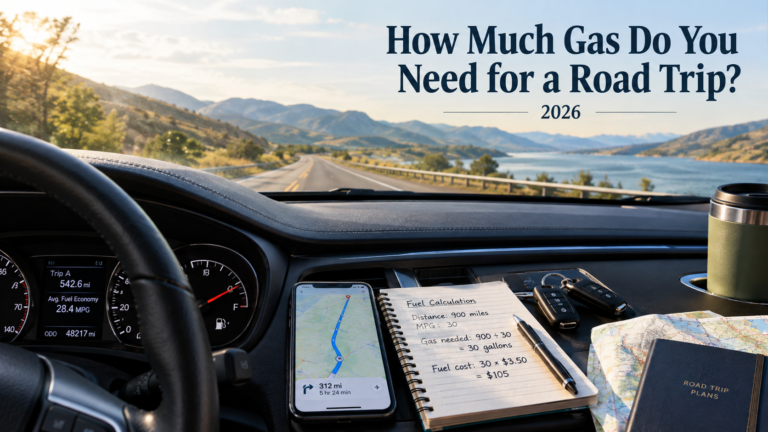
Simple Fuel Calculation
You can estimate fuel costs with three numbers:
Total miles ÷ vehicle MPG = gallons required
Then:
Gallons required × fuel price = estimated fuel cost
Example
Suppose your road trip is 1,200 miles and your vehicle averages 30 MPG.
1,200 ÷ 30 = 40 gallons
If you use an example fuel price of $3.50 per gallon:
40 × $3.50 = $140
So your estimated fuel cost would be $140.
That is an example calculation, not a current nationwide fuel-price estimate. Actual fuel prices can vary significantly between states, cities, highways, and travel dates.
Also remember that your real-world MPG may be lower than the vehicle’s advertised figure because of:
- Heavy luggage
- Passengers
- Mountain driving
- Traffic
- High speeds
- Weather
- Frequent stops
Don’t Forget the Return Trip
One of the easiest mistakes for beginners is calculating only the distance to the destination.
If you drive:
500 miles to your destination
and then drive:
500 miles home
your fuel calculation needs to use 1,000 miles, not 500.
Also add local driving.
For example:
500 miles outbound + 500 miles return + 150 miles local driving = 1,150 total miles
That extra 150 miles can come from sightseeing, restaurants, attractions, hotel transfers, and detours.
How to Make Your First Road Trip Less Stressful
1. Don’t Max Out Every Day
A common beginner mistake is planning 10 attractions in one day.
Instead, choose:
- One major destination
- A few worthwhile stops
- Time for meals
- A realistic arrival time
You’ll enjoy the trip more if you’re not constantly rushing.
2. Fill Up Before Long Scenic Sections
Some scenic roads don’t have frequent fuel stations.
The Blue Ridge Parkway, for example, has no gas stations directly along the Parkway.
The Kancamagus Highway also has no gas stations along its 34.5-mile stretch.
A full tank is cheap insurance against unnecessary stress.
3. Download Maps Before Leaving
Cell service can be unreliable in mountain, desert, and rural areas.
Download offline maps before entering areas where coverage may be limited.
4. Keep an Emergency Buffer
Don’t spend your entire budget on hotels and activities.
Keep extra money available for:
- Unexpected accommodation
- Vehicle repairs
- Extra fuel
- Weather-related changes
- Food
- Medical or roadside expenses
The exact amount depends on your trip and financial situation, but having a dedicated buffer is much safer than assuming everything will go perfectly.
5. Check Road Conditions Before Scenic Drives
Road conditions can change after you’ve planned your route.
The NPS currently advises travelers to check conditions and closures for routes such as the Blue Ridge Parkway and Glacier’s mountain roads. California also recommends checking current Highway 1 conditions before traveling.
Common First-Time Road Trip Mistakes
Driving Too Many Hours
A road trip isn’t a competition. If you arrive exhausted, you may not enjoy the destination.
Budgeting Only for Gas
Fuel is only one part of the total cost.
Ignoring Parking
Hotels, cities, beaches, attractions, and national parks can have different parking arrangements and fees.
Forgetting Local Driving
Your destination mileage isn’t your total mileage.
Booking Everything Too Late
Popular destinations can have limited accommodation during peak seasons.
Not Checking Seasonal Conditions
Mountain and scenic routes can have snow, closures, construction, flooding, or other temporary restrictions.
Treating GPS Time as Your Complete Schedule
Navigation apps generally calculate driving time, not the time you’ll spend taking photos, eating, using restrooms, looking for parking, or enjoying attractions.
FAQ:
Final Thoughts
The best road trip routes in the USA for first-time travelers aren’t necessarily the longest or most famous ones. The right route is one that fits your available time, driving experience, budget, vehicle, and interests.
If you’re new to road trips, start with a manageable itinerary. California Highway 1, the Florida Keys, a section of the Blue Ridge Parkway, or a shorter Utah loop can give you the experience of planning and driving a real road trip without requiring a massive commitment.
Before leaving, calculate your total mileage, estimate your fuel cost, price your accommodation and food, account for parking and activities, and keep an emergency buffer.
Most importantly, don’t plan every mile as if the goal is simply to reach the de