 DriveQuest
How to Plan a Road Trip Around National Parks
Planning a road trip around national parks sounds simple: choose a few parks, load the car, and start driving. In reality, the biggest challenge is fitting parks, driving time, fuel stops, lodging, reservations, food, and rest days into a route that does not leave you exhausted.
A good national park road trip is less about seeing the maximum number of parks and more about building a route you can actually enjoy.
This guide explains how to plan a road trip around national parks, from choosing your route and estimating driving time to budgeting for fuel, hotels, park fees, food, and unexpected expenses.
What Is the Best Way to Plan a National Park Road Trip?
The easiest approach is to plan your trip in this order:
- Choose your starting and ending points.
- Pick a realistic number of national parks.
- Group parks that are geographically close.
- Calculate total driving distance.
- Decide how many nights you need.
- Check park reservations and current conditions.
- Estimate fuel, accommodation, food, and entrance costs.
- Add extra time for stops and unexpected delays.
- Build a backup plan.
- Check your vehicle before departure.
This order matters because choosing too many parks before checking the distances can turn a relaxing vacation into a series of long driving days.
Step 1: Choose the National Parks You Actually Want to Visit
Start with your must-see parks rather than immediately creating a route.
Make a simple list such as:
| Park | Priority | Suggested Time |
|---|---|---|
| Park A | Must-see | 2–3 days |
| Park B | Must-see | 2 days |
| Park C | Optional | 1–2 days |
| Park D | Optional | 1 day |
Your list does not need to include every park in the region.
For a first trip, two or three parks can be enough for a week-long road trip, especially if you want time for hiking, scenic drives, photography, meals, and rest.
Think About Geography
Try to choose parks that naturally fit into the same route.
For example, a western national park trip might combine parks in the same general region instead of sending you hundreds of miles in the opposite direction between each stop.
Use mapping software to check the actual driving distances rather than estimating based on how close parks look on a map.
Step 2: Decide How Many Days You Really Have
Your available vacation time should determine the route—not the other way around.
Suppose you have eight days:
- Day 1: Drive to the region
- Day 2: National Park #1
- Day 3: National Park #1
- Day 4: Drive to National Park #2
- Day 5: National Park #2
- Day 6: National Park #2
- Day 7: Drive toward home
- Day 8: Return home
This gives you a much more realistic schedule than trying to visit five parks in eight days.
Leave Room Between Major Driving Days
If possible, avoid scheduling a long drive immediately before a demanding hiking day.
You may arrive at the park physically tired, then spend the next morning rushing through the experience.
A little breathing room can make the entire trip more enjoyable.
Step 3: Calculate the Total Road Trip Distance
Once you have your parks selected, calculate the complete route.
Do not only count the distance between your hotel and each park.
Include:
- Home to first destination
- Driving between parks
- Scenic detours
- Hotel-to-park drives
- Food and fuel stops
- Short sightseeing detours
- Return trip home
For example, imagine your route looks like this:
| Route Section | Distance |
|---|---|
| Home → Park 1 | 350 miles |
| Park 1 → Park 2 | 180 miles |
| Park 2 → Park 3 | 240 miles |
| Park 3 → Home | 420 miles |
| Local driving and detours | 160 miles |
| Estimated total | 1,350 miles |
That final number is much more useful for your fuel budget than simply adding the distances between the parks.
Step 4: Estimate Your Driving Time
Mileage alone does not tell you how long the trip will take.
A route that appears to be 300 miles may take much longer because of:
- Mountain roads
- Construction
- Traffic
- Weather
- Road closures
- Park entrance queues
- Scenic stops
- Wildlife-related slowdowns
- Parking problems
Avoid creating a schedule that assumes you will drive at maximum highway speed for the entire day.
A Better Rule
Treat your navigation app’s estimated driving time as the basic driving time, then add additional time for stops and conditions.
For example:
6 hours navigation time + 1.5–2 hours of stops = approximately 7.5–8 hours of travel time
The exact amount depends on your passengers and route.
Step 5: Check Park Reservations Before Finalizing Your Route
This is one of the most important parts of planning a national park road trip.
The National Park Service recommends checking each park’s official website for entrance fees, reservations, timed entry requirements, current conditions, and other planning information.
Requirements can vary significantly from park to park and can change from one year to another.
For example, Rocky Mountain National Park requires timed-entry reservations during certain periods in 2026, while Arches National Park does not require advanced timed entry in 2026.
That means you should never assume that a reservation rule you remember from another park—or another year—still applies.
Check These Before Leaving
For every national park on your route, look for:
- Entrance fees
- Timed-entry requirements
- Hiking permits
- Camping reservations
- Special attraction reservations
- Road closures
- Seasonal road openings
- Current alerts
- Weather conditions
- Parking restrictions
Check the official National Park Service information again shortly before your trip.
Step 6: Plan Your Route Around Overnight Stops
Your overnight location can have a major effect on your trip.
You generally have three choices:
Stay Inside the Park
This can reduce morning driving and put you closer to popular attractions.
The downside is that availability can be limited, particularly during busy travel periods.
Stay in a Gateway Town
Many parks have nearby towns with hotels, motels, restaurants, grocery stores, and fuel stations.
This can give you more accommodation choices.
Stay Somewhere Along the Route
Sometimes the cheapest or most practical option is not directly beside the park.
However, calculate the extra driving before booking.
A hotel that saves $40 but adds two hours of driving every day may not actually be the better value.
Step 7: Build a Realistic National Park Road Trip Budget
Your budget should include more than fuel and hotels.
A useful structure is:
| Expense | Example Budget |
|---|---|
| Fuel | $250 |
| Hotels/camping | $600 |
| Food | $400 |
| Park fees/reservations | $150 |
| Parking/tolls | $75 |
| Activities | $100 |
| Emergency buffer | $200 |
| Example total | $1,775 |
These are illustrative numbers, not current universal prices. Your actual costs will depend on the vehicle, route, number of travelers, accommodation, season, park fees, and spending habits.
Remember Park Entrance Costs
National park fees can vary by park.
The National Park Service also offers the America the Beautiful pass, which covers entrance fees and standard amenity fees at participating federal recreation sites. In 2026, the annual pass is listed at $80 for U.S. residents and $250 for non-U.S. residents.
There are also special fee rules for non-U.S. residents at certain national parks in 2026, so international visitors should check the current NPS information before budgeting.
Step 8: Calculate Your Fuel Budget
Fuel is one of the easiest road trip costs to estimate once you know your mileage.
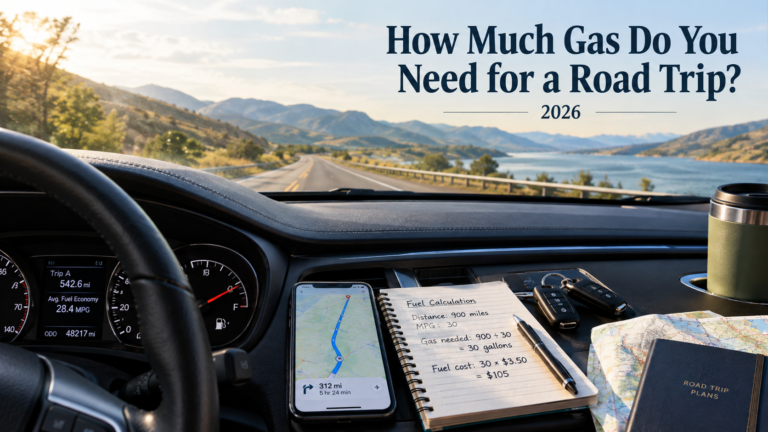
Use this formula:
Fuel needed = Total miles ÷ Vehicle MPG
Then:
Fuel cost = Gallons needed × Price per gallon
Example
Suppose your national park route is 1,350 miles and your vehicle gets 30 MPG.
1,350 ÷ 30 = 45 gallons
If fuel happens to average $3.50 per gallon along your route:
45 × $3.50 = $157.50
So the estimated fuel cost would be $157.50.
The actual amount can be higher or lower because fuel prices vary by location and date.
Add Some Extra Mileage
Your planned route is rarely your exact final mileage.
You may drive:
- From your hotel to trailheads
- Around the park
- To restaurants
- To grocery stores
- To viewpoints
- Around road closures or construction
Adding a reasonable mileage cushion to your estimate can prevent your fuel budget from being too optimistic.
Step 9: Plan Fuel Stops Before Remote Park Areas
Do not wait for the fuel warning light before thinking about your next gas station.
Some national park areas and long rural stretches have fewer services than you may be accustomed to.
Before entering a remote area, identify:
- Your current fuel level
- The next reliable fuel station
- Approximate distance
- Whether your route has alternative stations
- Whether weather or road closures could affect the route
Your goal is not to obsess over the fuel gauge. It is simply to avoid turning a normal road trip into an unnecessary problem.
Step 10: Plan Food Without Overcomplicating It
Food can quietly become a large road trip expense.
Eating every meal at restaurants, especially near popular tourist areas, can push your daily spending much higher.
A practical approach is to combine:
- Grocery-store breakfasts
- Packed lunches
- Road snacks
- Occasional restaurant meals
- Simple dinners
For example, keep a small cooler with:
- Water
- Fruit
- Sandwich ingredients
- Yogurt
- Cheese
- Simple snacks
You do not need to prepare every meal yourself.
The goal is simply to avoid having to buy expensive food whenever you become hungry.
Step 11: Schedule Fuel, Food and Rest Stops
A national park road trip is not just a line between destinations.
Plan stops around your natural route.
For example:
Fuel → restroom → groceries → lunch → scenic stop → hotel
Combining errands can reduce unnecessary backtracking.
It also gives everyone in the vehicle a chance to stretch and reset.
Step 12: Don’t Try to See Everything
One of the biggest mistakes first-time national park travelers make is creating an overloaded itinerary.
A park may have dozens of trails, viewpoints, scenic roads, visitor centers, lakes, waterfalls, and other attractions.
You do not need to see all of them.
Instead, choose:
- 2–3 must-see attractions
- 1–2 optional activities
- Time for spontaneous stops
If you finish your must-see list early, you can add something else.
That is much easier than trying to recover from an impossible schedule.
Step 13: Build Your Daily Schedule Around Park Conditions
Start by identifying the activities that have specific timing requirements.
For example:
Morning
- Enter park
- Hike
- Scenic viewpoint
Afternoon
- Lunch
- Short trail
- Visitor center
Evening
- Scenic drive
- Dinner
- Return to accommodation
If a park is especially busy, an early start may help you deal with parking and congestion.
But always follow current park guidance rather than assuming that arriving at a specific time guarantees access.
The NPS has noted that individual parks can use traffic and parking management when areas reach capacity.
Step 14: Check Weather and Road Conditions
Weather can completely change a national park road trip.
Depending on the park and season, you may encounter:
- Snow
- Heavy rain
- Strong winds
- Extreme heat
- Thunderstorms
- Flooding
- Smoke
- Temporary road closures
Check the official park website and alerts before driving.
If a major road or attraction is closed, do not build your entire day around reaching it.
Have a backup activity ready.
Step 15: Prepare Your Vehicle
A national park road trip can put more miles on your vehicle than a normal weekend drive.
Before leaving, check:
- Tire pressure
- Tire condition
- Engine oil
- Coolant
- Windshield washer fluid
- Brakes
- Lights
- Spare tire
- Jack and basic tools
- Battery condition
Also make sure you know where your vehicle’s roadside assistance information is stored.
Check Your Tires
Proper tire pressure can help your vehicle operate efficiently and safely.
Use the pressure recommended by your vehicle manufacturer rather than simply using a number printed on the tire itself.
Step 16: Create an Emergency Buffer
Do not spend your entire travel budget before the trip begins.
Keep some money available for unexpected expenses such as:
- Emergency accommodation
- Vehicle repairs
- Extra fuel
- Food
- Medical needs
- Route changes
- Unexpected parking or transportation costs
A useful approach is to create an emergency fund separate from your normal daily spending budget.
The exact amount depends on your trip length, vehicle, destination, and financial situation.
A Simple National Park Road Trip Planning Template
You can use this checklist when building your itinerary.
Before Booking
- Choose your national parks
- Check park opening information
- Check entrance fees
- Check reservations
- Calculate total mileage
- Estimate driving time
- Choose overnight locations
- Estimate fuel
- Estimate food
- Set an emergency buffer
Before Departure
- Check weather
- Check road conditions
- Check park alerts
- Confirm hotel or campsite
- Confirm timed-entry reservations
- Fill the fuel tank
- Check tires
- Check fluids
- Pack food and water
- Download or save important information
During the Trip
- Monitor fuel
- Take regular breaks
- Follow park rules
- Adjust the itinerary when conditions change
- Keep emergency funds available
- Avoid rushing to the next destination
Common Mistakes When Planning a National Park Road Trip
1. Choosing Too Many Parks
More parks do not automatically mean a better trip.
Every additional park can add driving, hotel changes, packing, unpacking, and logistical complexity.
2. Underestimating Local Driving
The distance from your hotel to a park entrance is not necessarily the distance you will drive inside the park.
3. Forgetting Reservations
Some parks or activities may require advance reservations or permits.
Always verify the current rules for your specific dates.
4. Budgeting Only for Gas
Fuel is only one part of the cost.
Hotels, food, entrance fees, parking, activities, and emergency expenses can add up quickly.
5. Creating an Overly Aggressive Schedule
Driving for hours and then immediately completing a demanding hike can leave you exhausted.
Build the itinerary around realistic energy levels.
6. Ignoring Seasonal Conditions
A route that works perfectly in summer may be very different during another season.
Check current conditions instead of relying on old trip reports.
7. Having No Backup Plan
A road closure, storm, full parking area, or unavailable campsite can change your day.
Keep at least one alternative activity or route in mind.
How to Save Money on a National Park Road Trip
You do not need to make your trip uncomfortable to reduce costs.
Try these practical strategies:
- Compare hotel prices in several nearby towns.
- Book accommodation based on the complete cost, not just the nightly rate.
- Pack snacks and some meals.
- Use grocery stores strategically.
- Combine fuel and grocery stops.
- Avoid unnecessary detours.
- Compare entrance-pass options when visiting multiple federal recreation sites.
- Travel during dates that fit your budget and schedule.
- Share driving and accommodation costs with compatible travel companions.
- Keep your vehicle maintained before the trip.
- Set a daily spending limit.
The biggest savings often come from better planning rather than extreme frugality.
How Many National Parks Should You Visit on One Road Trip?
There is no universal number.
For a short trip, one or two parks may provide plenty to explore.
For a longer trip, you may be able to comfortably include several parks if they are geographically close and you allow enough time at each one.
A useful question is:
“Would I rather spend another three hours driving to add one more park, or spend those three hours exploring the park I’m already visiting?”
That question can help keep your itinerary realistic.
Frequently Asked Questions
Final Thoughts
Learning how to plan a road trip around national parks is really about balancing your wish list with the time, money, and energy you actually have.
Start with a manageable group of parks, build a realistic route, calculate your total mileage, estimate fuel and accommodation, check current park requirements, and leave room for unexpected changes.
Before you leave, take one final look at park alerts, reservations, weather, road conditions, vehicle condition, and your emergency budget. A little preparation can help you spend less time worrying about logistics and more time enjoying the places you drove so far to see.