 DriveQuest
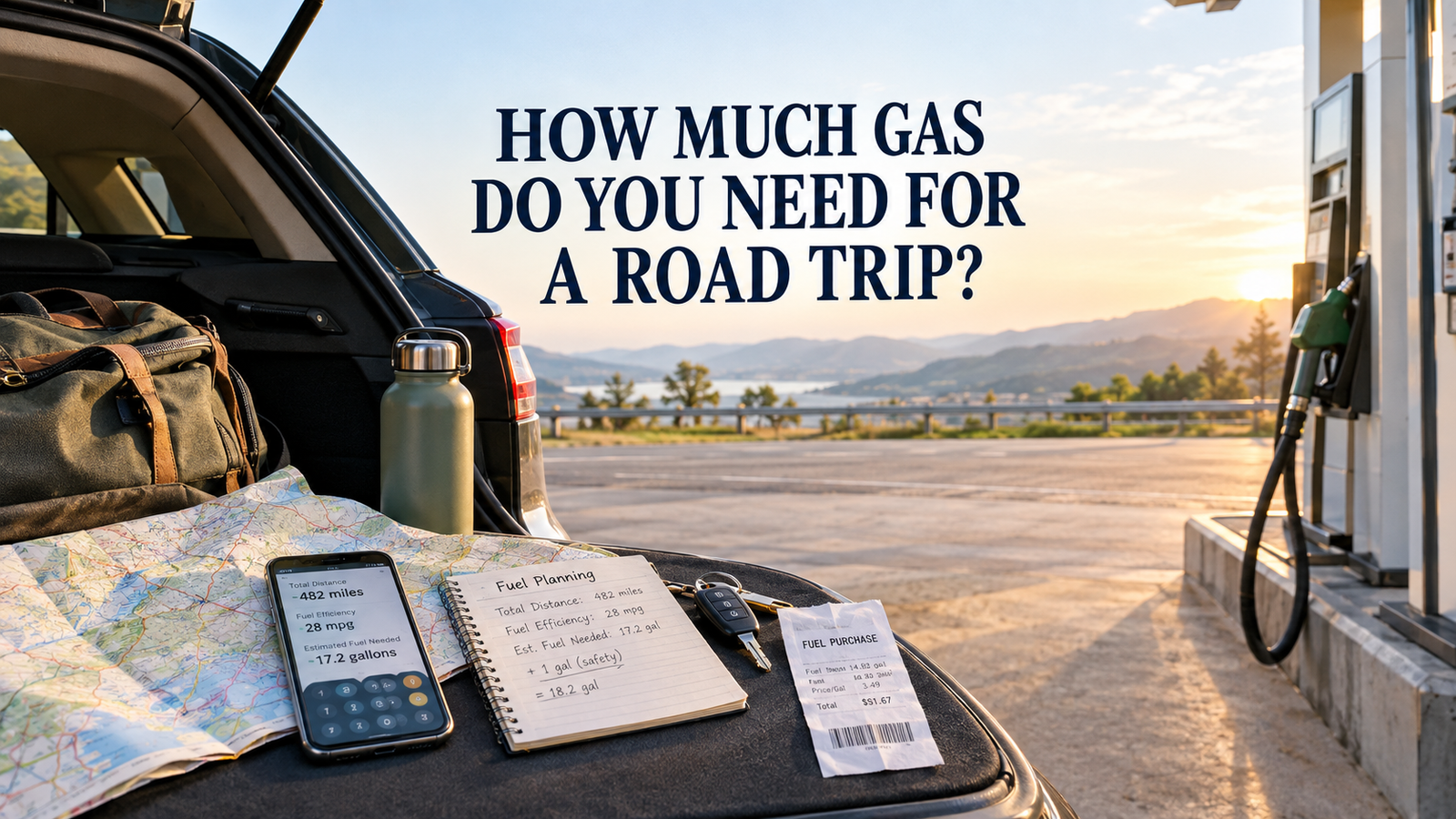
How Much Gas Do You Need for a Road Trip? A Simple Fuel Calculator Guide
Wondering how much gas you need for a road trip? You can get a surprisingly accurate estimate with just three pieces of information: your total driving distance, your vehicle’s fuel economy, and the current fuel price along your route.
For example, if your trip covers 900 miles and your car gets 30 MPG, you’ll need about 30 gallons of gas. At an example price of $3.50 per gallon, that would put your estimated fuel cost at $105.
The important part is calculating the whole trip, not just the distance from home to your destination. Here’s how to estimate your fuel needs, account for real-world driving conditions, and build a more realistic road-trip fuel budget.
How Do You Calculate How Much Gas You Need for a Road Trip?
The basic calculation is simple:
Fuel needed = Total trip miles ÷ Vehicle MPG
Then, to estimate the cost:
Fuel cost = Gallons needed × Price per gallon
Example: 900-Mile Road Trip
Suppose:
- Total distance: 900 miles
- Vehicle fuel economy: 30 MPG
- Example gas price: $3.50 per gallon
First, calculate the fuel:
900 ÷ 30 = 30 gallons
Then calculate the cost:
30 × $3.50 = $105
So you’d need approximately 30 gallons of fuel, with an estimated fuel cost of $105 at that example price.
Actual fuel prices vary by location and date, so treat this as a calculation example rather than a current price estimate.
The 3 Numbers You Need Before Calculating Fuel
You don’t need a complicated spreadsheet to estimate road-trip gas. Start with these three numbers.
1. Total Driving Distance
Find the approximate mileage for your entire route.
If you’re taking a round trip, don’t forget to include the return journey.
For example:
- Home to destination: 450 miles
- Destination back home: 450 miles
- Total: 900 miles
Also consider additional driving once you arrive.
If you’re staying in a city for three days and expect to drive another 100 miles sightseeing, your realistic trip distance becomes:
900 + 100 = 1,000 miles
That extra driving is easy to overlook.
2. Your Vehicle’s MPG
MPG means miles per gallon. It tells you approximately how many miles your vehicle can travel using one gallon of fuel.
Your actual MPG can differ from the number advertised for a vehicle.
Highway driving may produce different mileage from city driving, while heavy loads, traffic, weather, hills, and driving habits can also affect fuel consumption.
If you’ve tracked your vehicle’s actual fuel economy before, using your real-world MPG can make your estimate more useful.
3. Fuel Price
Fuel prices can vary significantly between cities, states, regions, and countries.
For a trip budget, you can:
- Check current prices before departure
- Look at prices along your planned route
- Use a slightly conservative estimate
- Recalculate during the trip if prices change
Don’t assume the price at your local gas station will be the same throughout the entire journey.
How Much Gas Do You Need for Different Road Trip Distances?
The amount of fuel you need depends heavily on your vehicle’s MPG.
Here’s a simple example using 30 MPG:
| Trip Distance | Fuel Needed at 30 MPG |
|---|---|
| 100 miles | 3.3 gallons |
| 250 miles | 8.3 gallons |
| 500 miles | 16.7 gallons |
| 750 miles | 25 gallons |
| 1,000 miles | 33.3 gallons |
| 1,500 miles | 50 gallons |
| 2,000 miles | 66.7 gallons |
These figures are mathematical estimates based on 30 MPG. Your vehicle may use considerably more or less fuel.
For example, a vehicle getting 20 MPG would need 50 gallons for 1,000 miles, while a vehicle getting 40 MPG would need only 25 gallons.
How to Calculate Road Trip Gas Cost
Once you know how many gallons you’ll need, calculating the estimated fuel cost takes one more step.
Fuel cost = Total miles ÷ MPG × Fuel price
You can combine everything into one formula:
Road trip fuel cost = (Total miles ÷ MPG) × Price per gallon
Example With a 1,200-Mile Trip
Imagine you’re driving 1,200 miles in a vehicle that averages 25 MPG.
1,200 ÷ 25 = 48 gallons
If your planning estimate is $3.60 per gallon:
48 × $3.60 = $172.80
Your estimated fuel cost would therefore be $172.80.
Again, this is an example using an assumed fuel price. The actual amount will depend on the prices you encounter.
Don’t Forget the Extra Miles
One of the most common fuel-budgeting mistakes is calculating only the main route.
Your navigation app might show 1,000 miles from your starting point to your destination and back, but your actual trip could involve considerably more driving.
Think about:
- Restaurants
- Hotels
- Scenic viewpoints
- National or state parks
- Attractions
- Grocery stores
- Detours
- Getting around your destination
- Searching for parking or alternate routes
Adding a reasonable mileage cushion can make your fuel estimate less likely to come up short.
For example, if your planned route is 1,000 miles, you might create your initial budget around 1,050 or 1,100 miles if you expect local driving and detours.
The right buffer depends on your itinerary rather than a universal percentage.
Highway MPG vs. City MPG
Your vehicle’s fuel economy isn’t always consistent.
Stop-and-go city traffic generally involves more frequent acceleration and idling than steady highway driving. Highway conditions can also vary, particularly with congestion, hills, strong winds, weather, and changes in speed.
For a mixed road trip, using a realistic average is often better than assuming you’ll achieve the vehicle’s best advertised mileage for the entire journey.
If you know your vehicle normally gets:
- 32 MPG on the highway
- 24 MPG in city driving
and your trip includes both, don’t automatically use 32 MPG for every mile.
A slightly conservative estimate can give your budget more breathing room.
What Can Increase Your Fuel Usage?
Several everyday factors can cause your actual fuel consumption to differ from your estimate.
Heavy Vehicle Loads
A car packed with several passengers, luggage, camping equipment, coolers, and other supplies may use more fuel than the same vehicle traveling with a light load.
You don’t need to obsess over every pound, but removing unnecessary items can make the vehicle easier to manage and may reduce wasted fuel.
Driving Speed and Style
Frequent hard acceleration, unnecessary rapid changes in speed, and other inefficient driving habits can increase fuel consumption.
Smooth, predictable driving is generally more appropriate for a long road trip than repeatedly accelerating and braking.
Traffic
A route that looks efficient on a map can become much less fuel-efficient if you spend a long time sitting in heavy traffic.
If your trip passes through major cities, consider when you’re likely to encounter congestion.
Weather and Terrain
Strong winds, steep grades, extreme temperatures, and difficult road conditions can affect fuel consumption.
This is another reason not to treat your calculated fuel requirement as an exact guarantee.
How Much Extra Gas Should You Budget For?
There isn’t one perfect amount of extra fuel for every road trip.
Instead of asking, “How many extra gallons should I buy?” think about how much additional driving your itinerary could realistically require.
For example, suppose:
- Planned distance: 1,000 miles
- Estimated MPG: 25
- Expected additional driving: 100 miles
Your adjusted distance becomes:
1,100 miles
Then:
1,100 ÷ 25 = 44 gallons
This approach is more useful than adding an arbitrary amount of fuel without considering your actual plans.
Also remember that you don’t need to carry all the trip’s fuel from the beginning. Most road trips involve refueling along the route.
How Often Will You Need to Stop for Gas?
Your vehicle’s fuel tank capacity matters here.
Suppose your car has:
- 14-gallon tank
- 25 MPG average
The theoretical range would be:
14 × 25 = 350 miles
However, that doesn’t mean you should plan to drive exactly 350 miles before looking for a gas station.
Your practical range depends on traffic, terrain, weather, fuel availability, and how much fuel you are comfortable leaving in the tank.
On long stretches of road with limited services, it’s sensible to plan fuel stops ahead rather than waiting until the fuel warning appears.
A Simple Road Trip Fuel Budget Example
Here’s what a basic fuel estimate could look like for a hypothetical trip.
| Item | Example |
|---|---|
| Planned distance | 1,200 miles |
| Estimated MPG | 25 MPG |
| Estimated fuel needed | 48 gallons |
| Example fuel price | $3.60/gallon |
| Estimated fuel cost | $172.80 |
| Extra mileage allowance | 100 miles |
| Adjusted distance | 1,300 miles |
| Adjusted fuel needed | 52 gallons |
| Adjusted fuel cost | $187.20 |
The adjusted figure provides a more realistic planning number if you expect additional driving.
These are illustrative calculations, not a universal road-trip cost. Change the mileage, MPG, and fuel price to match your own trip.
What If Your Vehicle Uses KM/L Instead of MPG?
If you’re planning a road trip in a country that uses kilometers and liters, you may see fuel economy listed as kilometers per liter (KM/L).
The basic calculation is similar:
Fuel needed = Total kilometers ÷ KM/L
For example, if your trip is 1,600 kilometers and your vehicle averages 12 KM/L:
1,600 ÷ 12 = 133.3 liters
So you’d need approximately 133 liters under those assumptions.
To estimate the cost:
133.3 liters × Price per liter = Estimated fuel cost
Make sure your distance, fuel economy, and fuel price all use compatible units before calculating.
Should You Use Your Car’s Advertised MPG?
You can use the manufacturer’s MPG figure as a starting point, but your actual results may differ.
Your road-trip conditions aren’t necessarily the same as the conditions used to determine official fuel-economy ratings.
For a personal trip budget, your own historical fuel records can be particularly useful.
If you’ve previously filled the tank and calculated your actual MPG over several trips, that information may provide a better starting point than relying entirely on a published rating.
How to Reduce Fuel Costs on a Road Trip
You don’t need extreme fuel-saving tricks to reduce your road-trip gas bill.
Compare Fuel Prices Along Your Route
Fuel prices can vary from one location to another. If you’re passing through several towns, checking prices before a planned stop can help you avoid unnecessarily expensive refueling.
Don’t drive far out of your way just to save a small amount, though. The extra mileage can cancel out the savings.
Keep Your Tires Properly Inflated
Check your tire pressure before leaving and follow the vehicle manufacturer’s recommended pressure.
Proper tire maintenance is also an important part of safe road-trip preparation.
Avoid Unnecessary Detours
A scenic detour can be worth it when it’s part of your trip.
But repeated out-of-the-way stops for small purchases, restaurants, or fuel can add mileage surprisingly quickly.
Combining errands and stops can keep your route more efficient.
Pack Some Food and Drinks
Bringing snacks and drinks can reduce the number of unnecessary stops.
It can also make long stretches of driving easier when there aren’t many convenient places to stop.
Don’t Sacrifice Safety to Save Fuel
Fuel savings should never come from unsafe driving.
Don’t speed excessively, skip necessary breaks, drive while tired, or continue driving when road or weather conditions are unsafe just to avoid an extra fuel stop.
A road trip budget is useful only if it supports a safe and manageable trip.
Common Road Trip Fuel-Budgeting Mistakes
1. Calculating Only the One-Way Distance
If you’re returning home by car, your return mileage needs to be included.
2. Forgetting Local Driving
Sightseeing, restaurants, shopping, and attractions can add hundreds of miles on a longer trip.
3. Using the Best Possible MPG
Planning around your vehicle’s most optimistic fuel economy can leave your budget too tight.
4. Assuming One Fuel Price
Prices can vary along your route, so don’t assume you’ll pay the same amount at every stop.
5. Forgetting Traffic and Weather
Real-world conditions can affect fuel consumption and driving distance.
6. Budgeting Only for Gas
Fuel may be a major road-trip expense, but it isn’t the only one.
A complete budget may also need to include:
- Accommodation
- Food
- Tolls
- Parking
- Attractions
- Vehicle maintenance
- Rental car costs
- Insurance
- Emergency expenses
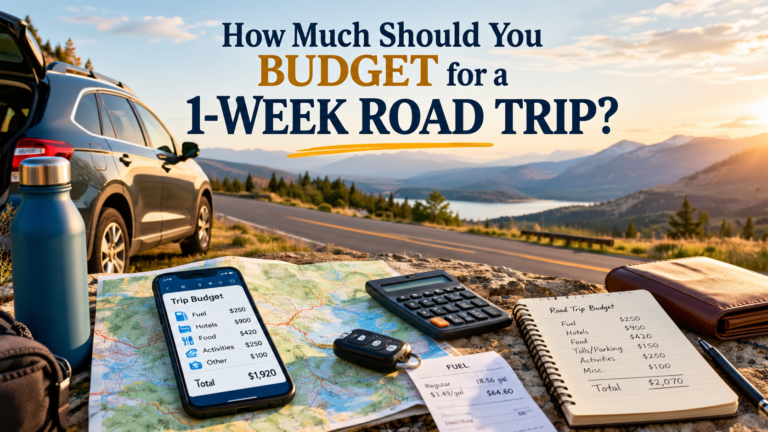
How to Build a Complete Road Trip Budget
Once you’ve calculated your fuel requirement, add the other major expenses.
A simple planning table might look like this:
| Expense | Estimated Cost |
|---|---|
| Fuel | $190 |
| Hotels | $450 |
| Food | $300 |
| Tolls | $75 |
| Parking | $50 |
| Activities | $150 |
| Emergency buffer | $200 |
| Estimated Total | $1,415 |
These numbers are purely illustrative.
Your actual cost will depend on the route, number of travelers, vehicle, accommodation choices, travel dates, activities, and local prices.
Add an Emergency Buffer
A road trip budget shouldn’t be designed so tightly that one unexpected expense causes a problem.
Your buffer could help cover an unexpected hotel night, minor vehicle issue, higher fuel costs, extra meals, or an unplanned route change.
The appropriate amount depends on your trip length and financial situation.
Quick Road Trip Gas Calculator
You can calculate your estimated fuel requirement in under a minute.
Step 1: Find Your Total Mileage
Include:
Outbound distance + return distance + expected local driving
Step 2: Find Your Realistic MPG
Use your vehicle’s typical fuel economy when possible.
Step 3: Calculate Gallons
Total miles ÷ MPG = Estimated gallons
Step 4: Estimate Fuel Cost
Estimated gallons × Fuel price = Estimated fuel cost
Example
1,500 miles ÷ 30 MPG = 50 gallons
At an assumed price of $3.50 per gallon:
50 × $3.50 = $175
So the estimated fuel requirement is 50 gallons, and the example fuel cost is $175.
That’s all you need for a basic calculation.
Frequently Asked Questions
Final Takeaway
Knowing how much gas you need for a road trip doesn’t require complicated math.
Start with your total mileage, divide it by your realistic MPG, and multiply the result by the fuel price you expect to encounter. Then add some room for local driving, detours, changing conditions, and price differences.
Before you leave, calculate your fuel requirement, build the rest of your road-trip budget, check your vehicle, and identify convenient fuel stops along the route.
A few minutes of planning can make it much easier to enjoy the drive without constantly wondering how much the trip is costing.